
Pinhaijing LAN Ethernet 2 Way Relay Board
4.8Editor score
Cost-Effective Two Channel Design
Web Server Interface Included
Compact PCB Footprint
This guide compares the top 10 Ethernet relay modules for industrial and smart home use, evaluating protocols, power options, and connectivity features.
Ethernet relay modules are essential components for automating industrial processes and smart home systems. They allow you to control high-power devices remotely using network connections, providing reliable switching capabilities for various applications requiring precise timing and automation.
We compared ten top-rated models based on their communication protocols, power supply options, and build quality. Our analysis focuses on reliability, ease of integration, and the specific features that matter most for professional and hobbyist projects alike.
Each selection below highlights key strengths and potential limitations to help you make an informed decision. Prices and availability can change frequently, so please verify the current listings before finalizing your purchase for your specific project needs.
4.8Editor score

4.8Editor score
4.7Editor score
This side-by-side comparison highlights the core specifications and unique attributes of each model to help you find the right fit for your networked control requirements.



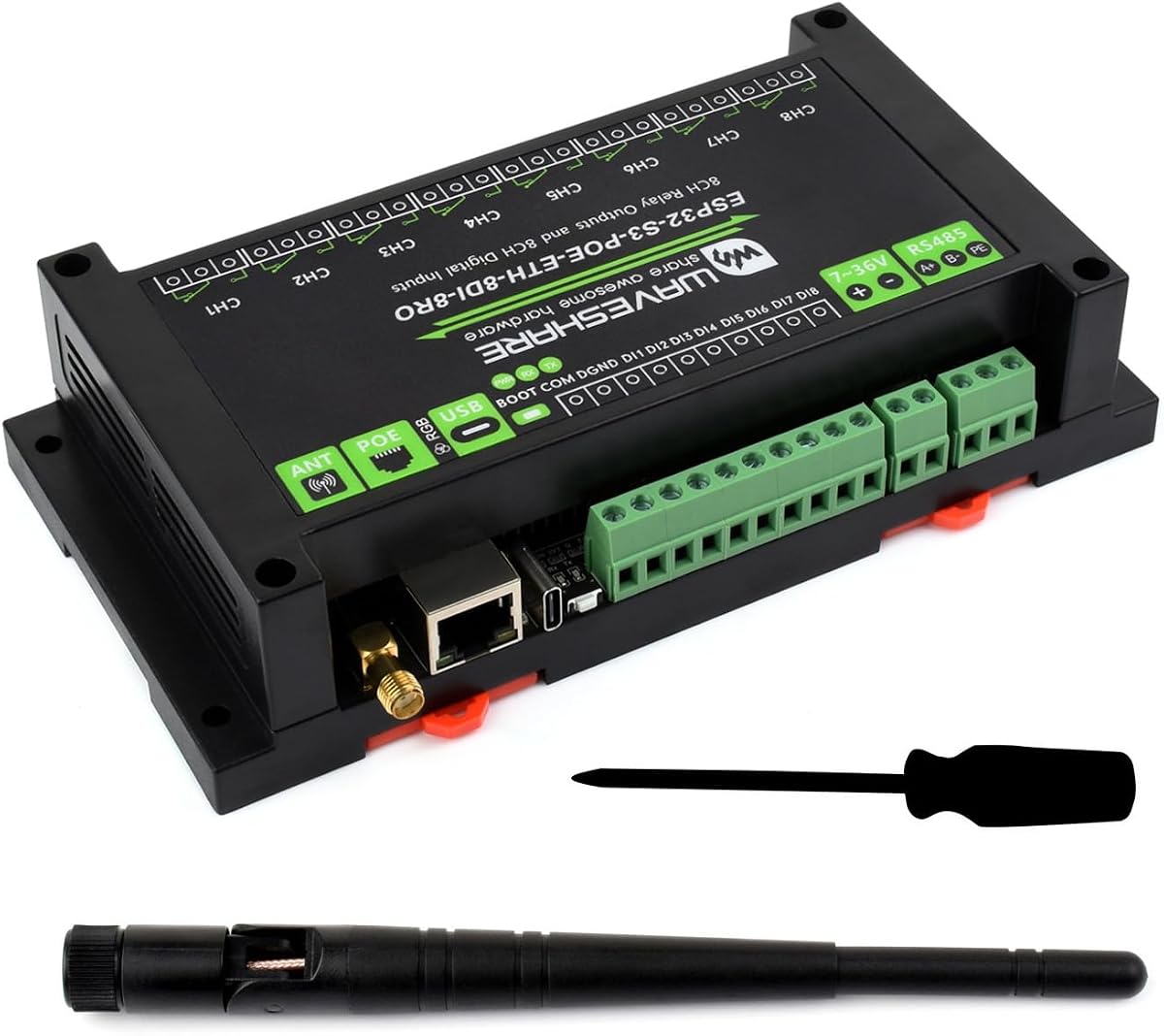
This industrial module stands out for its powerful ESP32-S3 microcontroller and versatile connectivity options. It achieves a high rating due to its ability to handle complex automation tasks while maintaining stable network performance.
We may earn a commission when you buy through this link, at no additional cost to you.
The onboard RS485 interface and built-in WiFi and Bluetooth LE dual-mode communication make it ideal for integrating with existing industrial systems or smart home setups. The 8-channel relay output can handle up to 10A 250V AC or 30V DC, allowing direct control of home appliances or low voltage devices.
While the price is higher than basic models, the added value of digital inputs and multiple isolation protections justifies the cost. The bi-directional optocoupler isolation ensures safety and reliability when connecting to sensitive circuits.
This module is best suited for professionals or advanced hobbyists who need a robust solution for remote control applications. Its combination of wired and wireless options provides the flexibility required for modern automation projects.
The integration of Ethernet, RS485, WiFi, and Bluetooth allows this module to adapt to various network environments and legacy systems.
Built-in isolation protection circuits and optocouplers prevent electrical interference and protect both the module and connected devices from damage.
We may earn a commission when you buy through this link, at no additional cost to you.
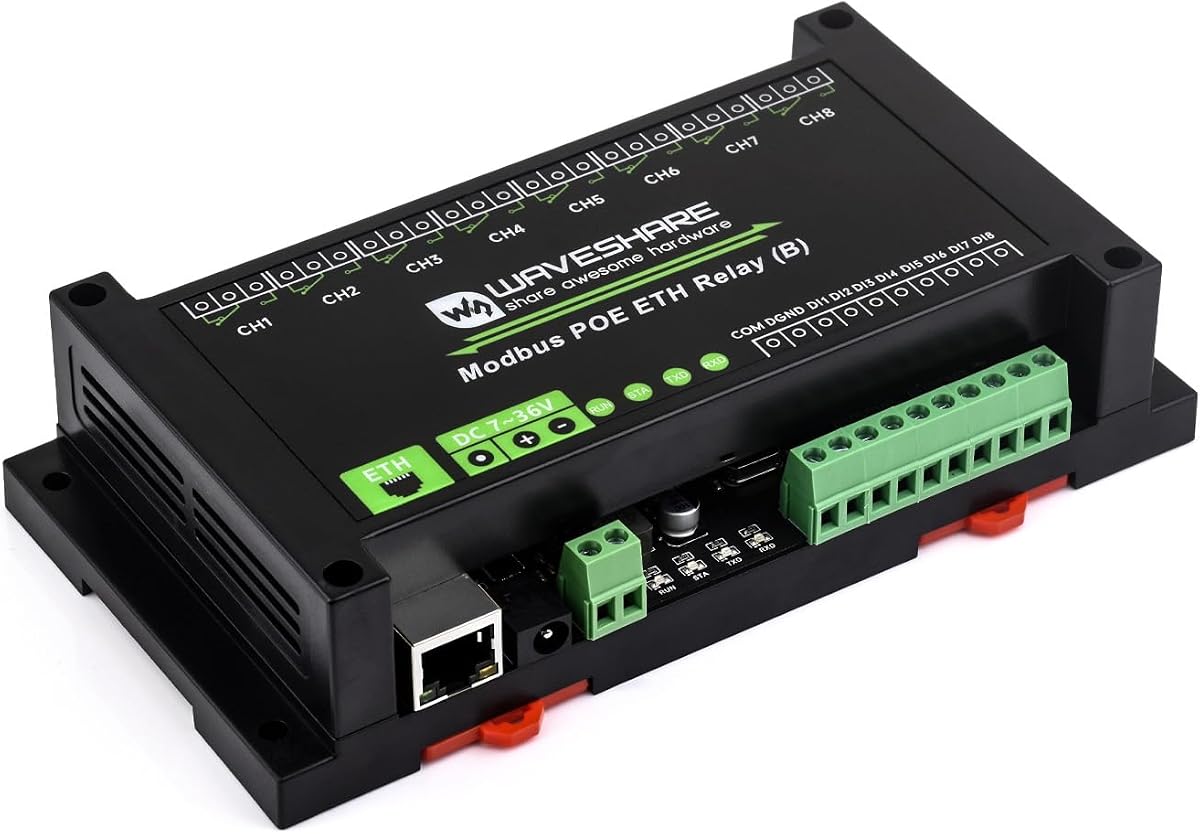
This Waveshare model focuses on robust industrial connectivity with its support for Modbus RTU and TCP protocols. It is designed for environments where stable wired communication is paramount for system integrity and operational safety.
We may earn a commission when you buy through this link, at no additional cost to you.
The module includes a PoE port for simplified power and data transmission over a single cable. It features an industrial grade rail-mount case for easy installation in control panels, along with onboard optocoupler isolation to protect against high-voltage interference.
Users should note that it lacks wireless capabilities, which may be a limitation for remote sites without existing Ethernet cabling. However, for stationary industrial applications, its reliability and standard protocol support are significant advantages.
This module is a solid choice for machinery control or facility automation where Modbus compatibility is required. Its sturdy build and isolation features ensure it can withstand the demands of a typical industrial environment.
Support for Modbus RTU and TCP ensures seamless integration with PLCs and other industrial controllers widely used in manufacturing settings.
PoE support reduces wiring complexity and potential points of failure in networked relay installations.
We may earn a commission when you buy through this link, at no additional cost to you.
This model is a top choice for those needing advanced wireless capabilities alongside traditional wired options. The ESP32-S3 microcontroller provides high processing power, enabling complex logic and faster response times in automation scripts.
We may earn a commission when you buy through this link, at no additional cost to you.
With integrated 2.4GHz Wi-Fi and Bluetooth LE, users can connect via mobile devices or remote servers without extra hardware. The onboard RS485 and Ethernet port ensure compatibility with industrial standards, while the 8-channel relays support high current loads.
The inclusion of digital inputs with bi-directional optocoupler isolation allows for monitoring sensor states alongside controlling outputs. This dual functionality makes it a versatile hub for comprehensive home or light industrial automation systems.
It is recommended for projects where flexibility in connection methods is crucial. The ability to switch between Ethernet, RS485, and wireless protocols ensures long-term usability as networks evolve.
The 32-bit LX7 dual-core processor running at 240MHz enables sophisticated logic processing and quick execution of automation tasks.
Passive and active digital inputs allow for monitoring a wide range of external sensors and switches securely.
We may earn a commission when you buy through this link, at no additional cost to you.
This module achieves a near-perfect rating by balancing ease of use with advanced features like digital inputs and multiple communication modes. It is designed to handle various industrial control scenarios with reliability and precision.
We may earn a commission when you buy through this link, at no additional cost to you.
The support for both Modbus RTU and TCP allows for seamless integration into existing networks. It offers multiple power supply options including PoE and a wide voltage range, ensuring it can be deployed in diverse environments without voltage concerns.
Digital inputs support passive and active contacts with bi-directional isolation, making it useful for triggering actions based on external events. The web browser configuration simplifies setup compared to purely software-based methods.
Ideal for users who need a mix of control and monitoring capabilities in a single device. Its robust design and high rating suggest it is a trustworthy component for critical automation tasks.
Support for PoE and wide voltage input reduces dependency on specific power supplies and simplifies wiring in remote locations.
Web browser and software configuration tools allow users to set up the module without deep programming expertise.
We may earn a commission when you buy through this link, at no additional cost to you.
This module offers a balanced set of features for advanced users seeking both wired and wireless connectivity. The ESP32-S3 processor ensures fast response times and the ability to run complex scripts locally.
We may earn a commission when you buy through this link, at no additional cost to you.
With onboard Ethernet and RS485 interfaces alongside WiFi and Bluetooth, it fits into various network architectures. The relay contact rating of up to 10A allows direct control of substantial loads like lighting or motors.
The availability of comprehensive SDK resources and online tutorials helps developers customize the module for specific applications. This support ecosystem reduces the barrier to entry for complex integrations.
It is recommended for developers who need a flexible platform for prototyping or deployment. The combination of powerful hardware and software support makes it a compelling choice for IoT projects.
The presence of SDKs and tutorials empowers developers to build custom solutions without starting from scratch.
High current ratings and multiple connection options ensure the module can handle demanding industrial applications.
We may earn a commission when you buy through this link, at no additional cost to you.
This module stands out for its 30-channel capacity, making it suitable for large-scale control projects where multiple devices need to be managed simultaneously. It maintains the reliability expected from industrial-grade components.
We may earn a commission when you buy through this link, at no additional cost to you.
The use of Modbus RTU and TCP ensures compatibility with many industrial control systems. PoE support simplifies deployment by allowing both data and power to be transmitted over a single Ethernet cable.
While the physical size is larger than standard 8-channel units, the space efficiency of having all outputs in one module often outweighs the bulk. The ABS rail-mount case protects the components and ensures easy installation in standard cabinets.
It is best for commercial or agricultural automation where many separate control points are required. Its high channel count reduces the need for multiple smaller modules, simplifying system architecture and management.
With 30 channels, this module supports complex systems without the complexity of daisy-chaining multiple devices.
Modbus and PoE adherence ensures it can plug into existing industrial infrastructure with minimal modifications.
We may earn a commission when you buy through this link, at no additional cost to you.
This premium model emphasizes performance and reliability with its high-speed processor and isolated interfaces. It is engineered for applications requiring precise timing and robust communication in demanding environments.
We may earn a commission when you buy through this link, at no additional cost to you.
The isolated RS485 interface prevents ground loops and noise interference, which is critical for long-distance communication. The RTC chip allows for scheduled tasks without needing constant external control, adding autonomy to the system.
With PoE support and comprehensive protection circuits, it is designed for long-term stability. The USB Type-C port facilitates easy firmware updates and debugging, which is a significant advantage for maintenance.
It is recommended for professional installations where reliability and precision are paramount. The high rating reflects its ability to deliver consistent performance over time under stress.
The onboard RTC chip enables accurate scheduling of relay operations independent of network latency or controller availability.
Isolated interfaces ensure data transmission remains reliable even in electrically noisy industrial settings.
We may earn a commission when you buy through this link, at no additional cost to you.
This module combines standard industrial protocols with practical features like digital inputs and built-in debounce logic. It is aimed at users who need reliable switching and status monitoring in a compact form factor.
We may earn a commission when you buy through this link, at no additional cost to you.
The dedicated relay driver chip ensures stable performance, and the reverse-proof circuit protects against accidental connection errors. Its industrial grade case is designed to be durable and easy to mount in professional settings.
While it lacks wireless capabilities, the Ethernet and PoE features provide a robust wired connection. The ability to link digital inputs with relay outputs allows for automated responses to sensor triggers.
It is well-suited for industrial control panels where wired reliability is preferred. The combination of protection features and standard protocols makes it a safe and effective choice for many applications.
Built-in debounce algorithms ensure stable digital input readings by filtering out electrical noise and contact chatter.
Reverse-proof circuits and dedicated drivers protect the hardware from user error and electrical spikes.
We may earn a commission when you buy through this link, at no additional cost to you.
This budget-friendly module provides essential network control capabilities for small-scale projects. It allows users to control two relays via TCP or UDP with a built-in web server for simple configuration and management.
We may earn a commission when you buy through this link, at no additional cost to you.
The compact PCB footprint and clear status indicators make it easy to integrate into custom enclosures or small boxes. Local password protection ensures that access to the control interface is secure without complex cloud setup.
While it lacks advanced industrial features like PoE or isolated inputs, it is perfect for hobbyist or light commercial use where simplicity and cost are primary drivers. Its high rating suggests it is reliable for its intended purpose.
It is recommended for beginners or projects with simple switching needs. The affordable price point allows for easy experimentation with networked automation without a large initial investment.
The integrated web server allows immediate control via a browser, making setup quick and intuitive for non-technical users.
Small physical size makes it ideal for tight spaces where larger industrial modules would not fit.
We may earn a commission when you buy through this link, at no additional cost to you.
This module offers a straightforward solution for networked relay control with a focus on standard industrial protocols. It supports Modbus RTU and TCP which makes it easy to integrate into existing PLC networks.
We may earn a commission when you buy through this link, at no additional cost to you.
Web browser configuration simplifies the setup process for users who prefer not to use dedicated software. The support for PoE power supply reduces wiring complexity and allows for cleaner installations in racks.
The industrial grade rail-mount case ensures durability and ease of installation in commercial settings. While it may not have as many advanced features as higher-end models, it delivers on the core requirement of reliable switching.
It is a good option for those who need a simple, protocol-compliant module without extra complexity. Its average rating reflects its focus on functionality and stability over flashy features.
Support for common protocols like Modbus ensures it can work seamlessly with a wide range of control systems.
Web-based settings allow for quick adjustments and setup without the need for specialized tools or software.
We may earn a commission when you buy through this link, at no additional cost to you.
Selecting the right Ethernet relay module requires understanding your specific network and power needs to ensure stable operation.
The protocol a module uses determines how it talks to your control system. Modbus RTU and TCP are industry standards that ensure compatibility with PLCs and other industrial controllers. If your system already uses Modbus, sticking to that protocol will save integration time and avoid complex translation layers.
Always verify that the module supports the specific protocol version you need. This ensures reliable data exchange and control without unexpected errors or downtime in your automated processes.
Relay modules can draw power from dedicated adapters or Power over Ethernet (PoE). PoE allows both data and power to be delivered over a single cable, which is ideal for locations where electrical outlets are hard to reach. This reduces wiring complexity and potential points of failure.
If PoE is not available, check the voltage range the module accepts. A wide range like DC 7 to 36V gives you flexibility to use various power adapters or battery setups depending on your project environment.
The number of relay outputs determines how many devices you can control with a single unit. Models range from 2-channel boards for simple tasks to 30-channel units for large systems. Consider future expansion needs so you do not outgrow the module quickly.
Check if the relays support AC or DC loads and their current ratings. Most modules support up to 10A 250V AC or 30V DC, which is sufficient for most appliances and industrial sensors. Matching this to your load prevents overheating or relay failure.
Some modules include WiFi and Bluetooth LE, offering flexibility when running Ethernet cables is not feasible. Wireless connections are useful for mobile applications or retrofitting old machines with remote control capabilities. However, wired Ethernet is generally more stable for critical operations.
If you choose a wireless module, ensure it supports the Wi-Fi standard your router uses. This prevents connectivity issues and ensures a strong signal even when the module is placed in a metal cabinet or enclosed space.
Beyond controlling outputs, digital inputs allow the module to read states from sensors or switches. This is crucial for systems that need to react to external conditions automatically. Look for modules that support both passive dry contacts and active wet contacts.
Isolation on inputs is important for safety and stability. Bi-directional optocoupler isolation prevents noise from affecting the logic board, ensuring accurate reading of signals even in noisy industrial environments.
Industrial environments can be electrically noisy and prone to accidents. Protection circuits like reverse-proof design prevent damage if you accidentally wire power backward. Optocoupler isolation keeps high-voltage relays separate from low-voltage logic.
Look for flyback diode protection if your relays drive inductive loads like motors. This prevents voltage spikes from damaging the board when the relay turns off. Robust protection extends the lifespan of your module significantly.
The physical form factor affects how easily the module fits into your control panel. Industrial modules typically come in rail-mount ABS cases that secure to DIN rails. This keeps the module stable and prevents it from moving around during vibration.
Ensure the case offers adequate ventilation or cooling for continuous operation. A well-designed case protects the internal components from dust and accidental contact, which is vital for maintaining reliability over time.
Setting up a relay module should be straightforward to save time. Look for modules that offer web browser configuration or software tools that run on standard operating systems. This avoids the need for complex command-line interfaces.
Check if the module supports dynamic IP assignment via DHCP. This simplifies network setup by automatically assigning an address, making it easier to integrate into existing local networks without manual configuration.
Start by connecting your power source correctly according to the module's voltage rating. If you are using PoE, plug the Ethernet cable directly into a PoE-enabled switch. Ensure all connections are tight to prevent intermittent signals or power drops during operation.
Configure the network settings through the provided web interface or software tool. Assign a static IP if your system requires it, or use DHCP for automatic assignment. Test the connection by pinging the module from a computer on the same network before connecting external devices.
Regularly update the firmware to benefit from security patches and performance improvements. Keep the module in a well-ventilated area and dust it gently with a dry cloth. Avoid exposing it to extreme temperatures or moisture unless it is rated for such conditions.
Modbus RTU is a serial communication protocol often used over RS485 or RS232 lines, while Modbus TCP is the same protocol adapted to run over Ethernet networks. TCP is generally faster and easier to integrate into modern IT systems, whereas RTU is common in older industrial setups.
Yes, many Ethernet relay modules support standard protocols that integrate well with home automation software like Home Assistant or openHAB. The built-in web servers or MQTT support make it easy to connect them to existing smart home hubs without extra hardware.
If you want to use Power over Ethernet to power the module, you will need an Ethernet switch that supports PoE or an injector. Without PoE, you will need to connect the module to a separate DC power adapter to provide power.
Look for features like optocoupler isolation, reverse-proof circuit design, and robust housing. These protect the module from electrical spikes, accidental wiring errors, and physical damage, ensuring safer operation in both home and industrial environments.
Yes, if the module supports cloud connectivity or port forwarding. Some models have built-in cloud demos like Alibaba Cloud MQTT. For others, you may need to set up your own remote access using a VPN or secure gateway.
Many of the ESP32-S3 models are fully compatible with the Arduino IDE and provide extensive SDKs. This allows you to write custom firmware to extend functionality beyond standard configurations or integrate them into larger Arduino projects.
Check the module's specifications for the supported voltage range. Most industrial modules accept a wide range like DC 7 to 36V. Using a voltage outside this range can damage the unit, so always match your power supply to the rated input.
The mechanical relays are typically rated for over a million operations, but electronic components last longer. Proper ventilation and stable power supplies help extend the lifespan significantly. Avoid overloading the relays beyond their current rating to ensure longevity.
We have explored ten distinct options ranging from simple 2-channel boards to complex 30-channel industrial units. The Industrial 8-Ch ESP32-S3 models stood out for their versatility, while the Pinhaijing board remains a great entry point for budget-conscious users.
When choosing, prioritize communication protocols and power options that match your existing infrastructure. Wireless connectivity is a bonus but should not come at the cost of reliability if your application requires constant uptime.
Always check current pricing and availability as these factors fluctuate over time. By selecting a module that meets your specific power and protocol needs, you ensure a stable and scalable automation system for the future.