Rad Triage 50
4.4Editor score
Wallet portable size
No batteries required
Military-grade construction
This comprehensive guide compares the top ten radiation dosimeters available in October 2026, evaluating accuracy, features, and portability to help you choose
Radiation dosimeters are essential tools for anyone concerned about environmental safety, nuclear hazards, or industrial exposure. These devices detect ionizing radiation such as alpha, beta, and gamma rays, providing critical data to ensure personal safety and informed decision-making in various settings.
To compile this list, we evaluated ten highly rated dosimeters based on user feedback, technical specifications, and real-world performance. We considered factors like sensor accuracy, display readability, battery life, and additional features such as data logging and alarm systems to ensure a balanced selection for diverse needs.
Each pick in this guide highlights unique strengths tailored to different user scenarios, from casual hobbyists to professionals. While we strive for accuracy, product availability and pricing can change frequently, so please verify current details on the retailer sites before making a final purchase decision.
4.4Editor score

4.6Editor score

4.6Editor score
The following table provides a side-by-side comparison of the ten leading dosimeters evaluated in this guide. It highlights key specifications, sensor types, and unique features to help you quickly identify the model that best fits your specific monitoring requirements and budget constraints.


The GQ GMC-800 stands out as the premier choice for radiation monitoring in November 2026. Rated 4.6 by users, this device offers a perfect blend of high precision and user-friendly operation. Its ability to detect beta, gamma, and X-ray radiation makes it a versatile tool for various safety scenarios.
We may earn a commission when you buy through this link, at no additional cost to you.
Accuracy is the standout feature here, as it meets USA national standards like NIST and NRC. The large color LCD ensures readings are visible even in bright sunlight. Additionally, the five alarm types provide robust security for users with different sensory needs, ensuring no alert is missed.
While the device is powerful, it lacks the smallest form factor compared to pocket models. However, the inclusion of a stand and handheld design mitigates this issue effectively. The price is higher but justified by the professional-grade accuracy and extensive feature set.
This device is ideal for professionals, researchers, or serious enthusiasts who need reliable and certified radiation data. Its global data sharing and long-term storage capabilities make it a worthy investment for long-term safety planning.
The GQ GMC-800 complies with strict USA national standards such as NIST and NRC, ensuring that every reading you take is scientifically valid and trustworthy for critical decisions.
With visual, audio, vibration, and voice alarms, this device ensures that alerts are perceived regardless of environmental noise or user hearing capabilities, providing comprehensive safety coverage.
We may earn a commission when you buy through this link, at no additional cost to you.
The GQ GMC-300S is a robust digital detector designed for those who value detailed data logging without breaking the bank. It excels at capturing real-time data every second, which can be downloaded for later analysis. This feature makes it highly useful for environmental surveys.
We may earn a commission when you buy through this link, at no additional cost to you.
Its rechargeable battery ensures that you are not constantly replacing cells, which is eco-friendly and cost-effective. The inclusion of free PC software allows for easy visualization of the radiation data collected over time, making it a great tool for hobbyists.
The device lacks some of the high-end alarm features found in top-tier models like the GMC-800. However, for basic monitoring needs where data retention is the priority, it performs exceptionally well without unnecessary complexity or bulk.
Buyers looking for a balance between functionality and simplicity will appreciate this model. It is best suited for users who want to track radiation trends over periods rather than just getting instantaneous spot checks.
Every second of radiation data is logged internally, allowing you to review past exposure trends and export detailed reports to your computer for further analysis.
The device comes with a rechargeable battery system, reducing long-term costs and waste associated with disposable batteries while ensuring longer usage between charges.
We may earn a commission when you buy through this link, at no additional cost to you.
The GQ GMC-800 V2 offers similar performance to the standard model but with a focus on advanced connectivity and update capabilities. It is designed to be future-proof, allowing for firmware updates and online data storage which is vital for maintaining accuracy over time.
We may earn a commission when you buy through this link, at no additional cost to you.
Users will appreciate the anti-drop design which ensures the device survives accidental impacts during field use. The large color LCD remains a highlight, providing clear visibility and ease of use in various lighting conditions, which is critical for safety.
The complexity of the menu system can be a slight hurdle for those who prefer instant usability. However, the advanced features like global data sharing justify this for professional users who need detailed logging and collaborative analysis.
This variant is best for users who want the latest software features and global connectivity options. It is a solid investment for professionals who require a device that evolves with technological standards and maintains high precision.
The ability to receive online firmware updates ensures that your detector stays current with the latest scientific standards and operational improvements without needing to buy a new unit.
Data can be shared globally, allowing multiple users to access and analyze radiation levels from different locations, enhancing team safety protocols and collaborative monitoring efforts.
We may earn a commission when you buy through this link, at no additional cost to you.
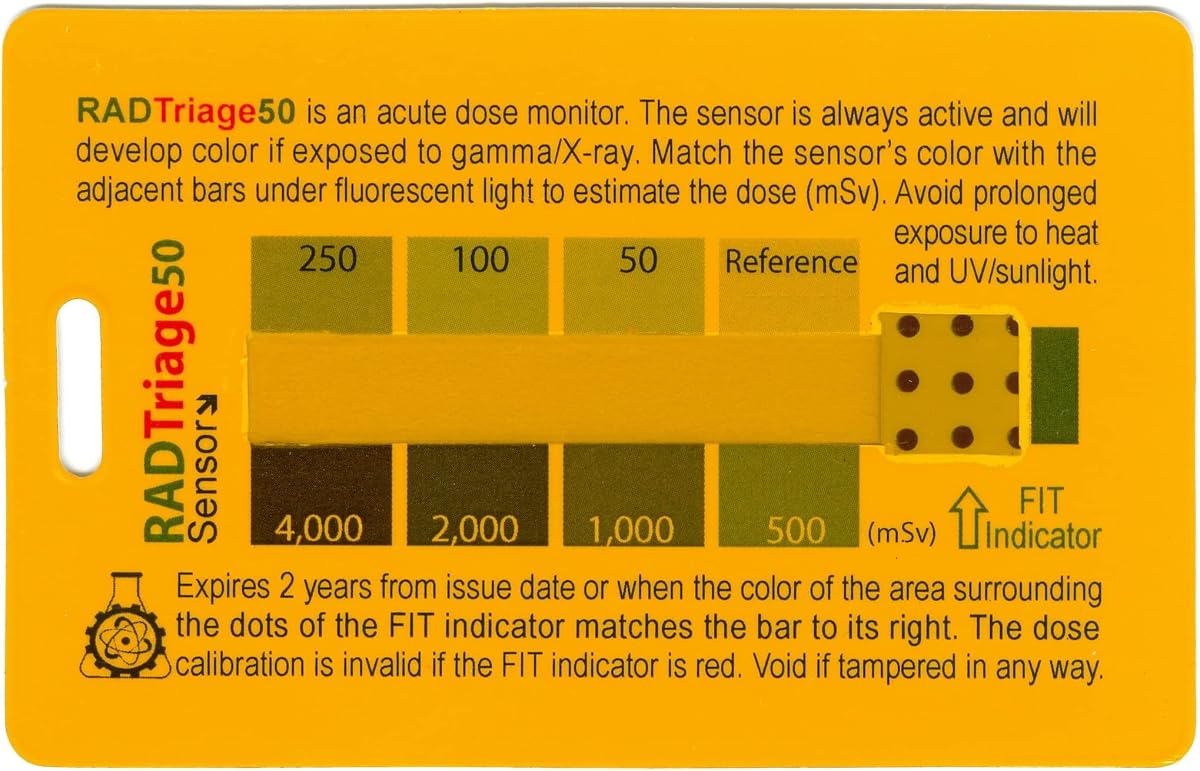
The Rad Triage 50 is a unique device that prioritizes simplicity and emergency readiness over digital metrics. It is a passive detector that fits in a wallet and provides a visual indication of radiation exposure without needing any batteries or electronic components.
We may earn a commission when you buy through this link, at no additional cost to you.
Its military-grade testing and approval by the US Dept of Homeland Security make it a trustworthy option for emergency kits. The ability to store it in a freezer extends its shelf-life up to ten years, ensuring it is always ready for a crisis.
It does not provide real-time data or digital numbers, which limits its use for precise environmental surveys. However, for personal emergency preparedness where a simple warning signal is sufficient, it is unmatched in reliability and convenience.
Buyers seeking a backup emergency tool should definitely consider this model. It is perfect for keeping in a car or go-bag, offering peace of mind that you have a radiation warning system without worrying about dead batteries or calibration.
This device requires no batteries or calibration, meaning it is always ready to detect radiation levels instantly in an emergency situation without any maintenance checks.
Storing the device in a freezer can extend its usable shelf-life to ten years, ensuring that you have a reliable radiation detector available for decades without degradation.
We may earn a commission when you buy through this link, at no additional cost to you.
The APOWER RD-3 is a reliable and affordable option that focuses on user safety through its triple alarm system. When radiation levels exceed the threshold, visual and audible alerts activate immediately, ensuring you are aware of danger even if you are not looking at the screen.
We may earn a commission when you buy through this link, at no additional cost to you.
The color LCD display is bright and easy to read, making it simple to track real-time dose equivalent. The USB-C charging and long battery life of up to 8 days mean you can rely on it for extended field trips without frequent recharging.
While it does not offer the deep data logging capabilities of high-end models, it performs its core function of detection effectively. It is robust and lightweight, making it easy to carry in a shirt pocket during home improvements or inspections.
This device is ideal for homeowners and contractors who need a quick and safe way to check for radiation in environments like marble shops or renovation sites. It offers excellent value for the price with essential safety features.
The triple alarm system ensures that you are immediately notified of high radiation levels through sound, lights, and screen alerts, providing critical safety during field work.
Powered by a rechargeable lithium battery, this detector can last up to 8 days on a single charge, allowing for long-duration monitoring without the need for extra power sources.
We may earn a commission when you buy through this link, at no additional cost to you.
The AEGTEST Radar-5633 distinguishes itself by displaying multiple data points simultaneously on a single clear interface. This allows users to monitor dose rate, count rate, and cumulative dose without switching screens, which streamlines the monitoring process effectively.
We may earn a commission when you buy through this link, at no additional cost to you.
Its battery life is impressive, lasting up to 18 days with sound turned off, making it highly reliable for long-term environmental surveys. The use of semiconductor sensors provides a good balance of cost and performance for general radiation detection needs.
Some users may find the accuracy rating slightly lower than premium models, which is a trade-off for the versatile data display and battery life. However, it remains a strong contender for those who need to track various metrics without constant interruptions.
This model is best suited for users who want to track multiple radiation metrics simultaneously. It is a solid choice for environmental monitoring where detailed data trends are more important than pinpoint professional-level precision.
The interface displays dose rate, average dose rate, count rate, and cumulative dose all at once, saving you time and effort in switching between different modes.
With a battery life of up to 18 days on a single charge, this device is ideal for extended monitoring sessions where frequent recharging is not feasible.
We may earn a commission when you buy through this link, at no additional cost to you.
The HFS-50-CsI is a high-end detector that uses a CsI scintillator sensor, offering significantly better sensitivity and stability than traditional Geiger tubes. This makes it ideal for detecting low levels of radiation and provides reliable data for laboratory or professional environmental use.
We may earn a commission when you buy through this link, at no additional cost to you.
Its battery life is legendary, lasting up to 1700 hours in sleep mode, which is approximately 70 days. This ensures that the device is ready whenever needed without frequent charging. The included telescopic rod allows for safe distance measurements from high-radiation sources.
While the price is higher than most other models, the superior sensor quality and battery life justify the cost for professionals. The dynamic waveform display provides a visual representation of radiation changes which is very helpful for analysis.
This model is best for professionals and serious hobbyists who require maximum sensitivity and reliability. It is an investment that pays off in accuracy and convenience, especially for long-term monitoring in challenging environments.
The CsI scintillator sensor offers better interference resistance and stability compared to traditional tubes, providing more accurate data for precise radiation detection needs.
The included telescopic rod allows you to maintain a safe distance from potential radiation sources while still getting accurate readings, enhancing personal safety during inspections.
We may earn a commission when you buy through this link, at no additional cost to you.
The GQ GMC-500Plus is an enhanced model featuring dual Geiger tubes, which significantly extends the upper detection range. This makes it highly effective for environments with higher radiation levels where standard single-tube detectors might saturate or become inaccurate.
We may earn a commission when you buy through this link, at no additional cost to you.
It supports unlimited server logging, allowing you to upload data to any server worldwide automatically. This is a powerful feature for researchers who need to monitor radiation in real-time and share results with a remote team instantly.
While it lacks a color screen, the large LCD with auto font adjustment ensures readability. The independent calibration factors for each tube improve accuracy, making it a robust choice for serious monitoring tasks where precision is critical.
Buyers who need high-range detection and server logging should prioritize this model. It is a workhorse designed for reliability and data sharing, making it a top choice for scientific and industrial applications.
The dual GM tubes allow for a detection range that is ten times higher than standard models, ensuring accuracy even in areas with elevated radiation levels.
Unlimited server logging enables you to share radiation data with anyone in the world automatically, facilitating real-time monitoring and collaborative safety efforts.
We may earn a commission when you buy through this link, at no additional cost to you.
The MOESAPU FS5000 is a personal guardian designed to be always at hand thanks to its clip design and comprehensive alert system. It uses sound, light, and vibration to warn you of radiation exposure, ensuring you are alerted even in noisy environments.
We may earn a commission when you buy through this link, at no additional cost to you.
It offers a 30-day runtime on a full charge when using low power mode, which is highly convenient for long trips. The live graph tracking helps you follow exposure trends at a glance, making it easy to understand radiation fluctuations.
While the display may suffer from some glare in direct sunlight, the features compensate for this with a long battery life and versatile alarm system. The J321 sensor provides a good level of sensitivity for general household and hobbyist use.
This device is ideal for those who want a portable companion for travel or daily use. Its low power mode ensures it is always ready to alert you, making it a reliable choice for personal safety on the go.
The combination of audio, visual, and haptic alerts ensures you are notified of radiation risks regardless of your current activity or environmental noise levels.
With up to 30 days of runtime on a full charge, this device can accompany you on extended trips without the worry of needing frequent recharging.
We may earn a commission when you buy through this link, at no additional cost to you.
The Soogua Geiger Counter is designed for wide application scenarios ranging from home improvement to seafood detection. It offers four alarm modes including vibration and light, ensuring that you are aware of radiation risks in various environmental conditions.
We may earn a commission when you buy through this link, at no additional cost to you.
Its high precision sensor allows it to detect low dose environments effectively. The customizable settings let you tailor the alarm thresholds and screen brightness to your specific needs, making it adaptable for many different types of monitoring tasks.
While the interface is basic and battery life is average, the versatility of this device makes it a strong candidate for general users. It is a solid all-rounder that covers a broad range of detection scenarios without specialized high-end features.
Buyers looking for a versatile tool for home or light professional use will find this model practical. It offers reliable detection and useful customization options at an accessible price point for general radiation monitoring needs.
Designed for a broad range of applications from home improvements to industrial inspections, this detector adapts to many different environments for comprehensive safety checks.
You can adjust alarm thresholds and screen brightness to match your environment, ensuring that the device fits your specific usage scenarios and comfort preferences.
We may earn a commission when you buy through this link, at no additional cost to you.
Selecting the right dosimeter involves understanding your specific monitoring needs, the types of radiation you expect to encounter, and the features that matter most to your workflow. This guide breaks down the key factors to consider before making your purchase.
The sensor is the heart of any dosimeter. Geiger-Müller tubes are common and cost-effective for general detection, while CsI scintillator sensors offer higher sensitivity and better stability for professional use. Semiconductor sensors provide a balance of cost and performance.
Choose a sensor type based on your required sensitivity and budget. High-end sensors like CsI are worth the investment for professionals who need precise data.
Different devices cover different ranges of radiation intensity. If you plan to inspect high-radiation areas like nuclear facilities, ensure the device has an upper limit that won't saturate. For general home use, standard ranges are usually sufficient.
Always check the cumulative dose and dose rate range to ensure the device fits your specific environment. An inadequate range can lead to inaccurate readings or device failure.
A clear display is critical for safety. TFT color LCD screens offer better visibility and data visualization compared to simple monochrome displays. Look for devices with adjustable brightness to ensure readability in sunlight.
Prioritize screens that show multiple metrics without constant switching. This reduces errors and ensures you have all necessary data at a glance during monitoring.
Some devices offer internal memory to store historical data, while others connect to computers or servers. For long-term environmental monitoring, data logging is essential to track trends over time and prove compliance.
If you need to analyze trends later, choose a model with free software or cloud sharing capabilities. This allows you to review exposure history without needing to constantly watch the device.
Rechargeable batteries are becoming standard, but longevity varies. Some models offer up to 18 days of use on a single charge. Long battery life is crucial for travel or extended fieldwork where charging options are limited.
Check the manufacturer's claimed battery life and look for models with low power modes. This ensures your device remains operational during critical monitoring periods without interruption.
Visual and audible alarms are standard, but advanced models include vibration or voice alerts. For safety, a multi-modal alarm system ensures you are notified even if one sense is compromised or the environment is noisy.
Ensure the device allows for customizable thresholds. This lets you set alarms based on your safety standards rather than default settings that may be too high or too low.
Consider how you will carry the device. Some models are pocket-sized, while others require a handheld grip. Features like wrist straps or telescopic rods can enhance portability and safety in field conditions.
Choose a form factor that matches your typical usage. A compact wallet device is better for emergency carry, while a handheld unit suits professional field inspections.
For professional use, ensure the device meets industry standards like NIST or NRC. Compliance guarantees that the device is calibrated correctly and provides trustworthy data for regulatory or scientific purposes.
If you are using the device for official safety checks, always verify its compliance status. Using non-compliant devices can lead to inaccurate data and potential safety risks.
Start by reading the user manual thoroughly to understand the specific features of your model. Turn on the device and allow it to initialize. Place it in the area you wish to monitor, ensuring it is placed on a stable surface or held steadily.
Observe the readings displayed on the screen. If the device shows a sudden spike, follow the safety protocols provided in the manual. For devices with alarms, set the threshold to the recommended safety level for your environment before starting monitoring.
After use, turn off the device properly and store it in a dry and clean place. Regularly check the battery level and recharge as needed. If your device supports data logging, download and save the data to keep a record of radiation levels over time.
A radiation dosimeter is used to measure the dose of ionizing radiation absorbed by a person or object. It helps ensure safety in environments like hospitals, nuclear power plants, and industrial sites by detecting radiation levels and alerting users to potential hazards.
While they are often used interchangeably, a Geiger counter typically measures instantaneous radiation levels (count rate), whereas a dosimeter measures the accumulated dose over time. Many modern devices combine both functions for comprehensive monitoring.
Consumer dosimeters can be quite accurate for general monitoring, especially those certified by standards like NIST. However, professional models may offer higher precision and stability. Accuracy can vary based on the sensor type and calibration.
Most dosimeters detect beta, gamma, and X-ray radiation. Some models may detect alpha radiation but often require a window or specific sensor. Check the specifications to ensure the device covers the specific types of radiation you need to monitor.
Ideally, you should calibrate your dosimeter once a year or as recommended by the manufacturer. Regular calibration ensures that the readings remain accurate and trustworthy over time.
Most modern electronic dosimeters require batteries or rechargeable power. However, passive detectors like the Rad Triage 50 do not need batteries and rely on physical changes to indicate exposure.
Choosing the right dosimeter depends on your specific needs, whether you require high precision for professional work or a simple tool for personal safety. The GQ GMC-800 stands out as the top choice for its accuracy, while the Rad Triage 50 offers unmatched convenience for emergency preparedness.
For those seeking a balance between features and price, the APOWER RD-3 and AEGTEST Radar-5633 provide excellent value. If you prioritize sensor quality and battery life, the HFS-50-CsI is the premier option despite its higher cost.
Radiation safety is paramount, and investing in a reliable device is always worth the effort. Please verify current prices and availability on the Amazon links provided, as these details may change frequently.