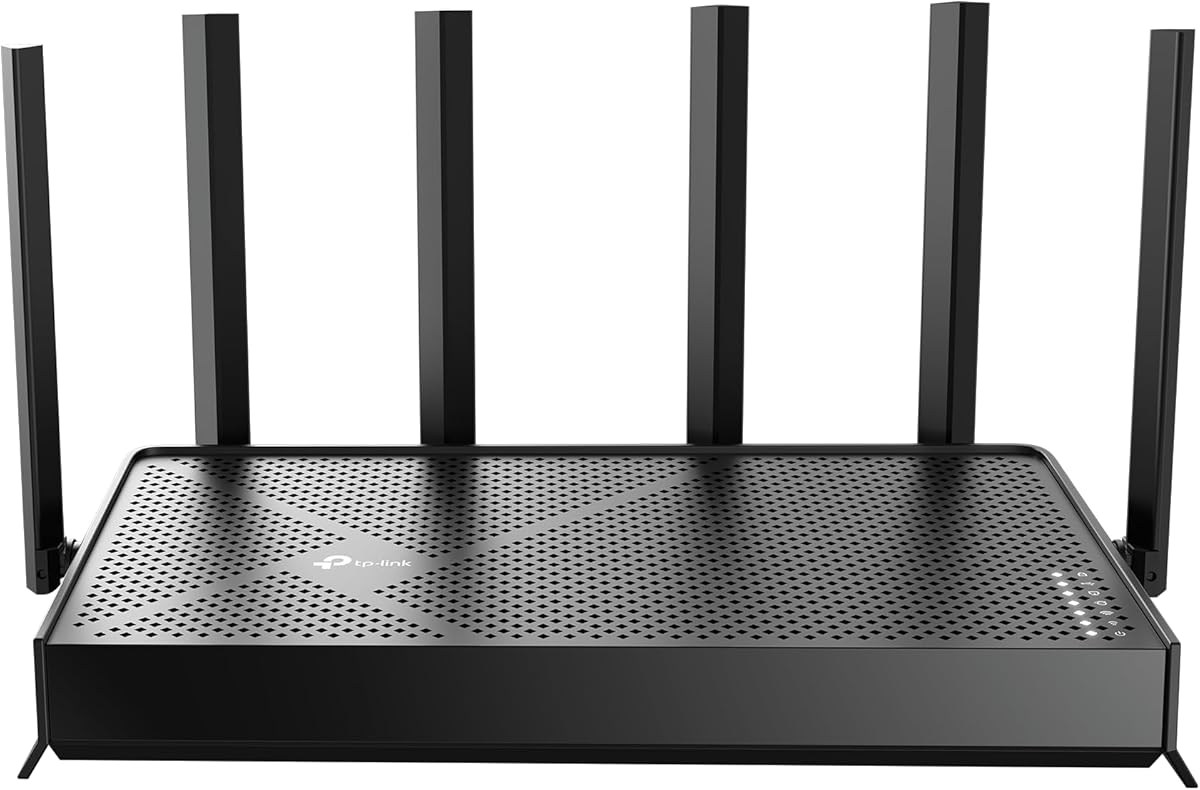
TP-Link BE6500 Dual-Band WiFi 7 Router
4.3Editor score
Multi-Link Operation support
2.5 Gbps wired ports
HomeShield security included
This guide compares the top 10 commercial wireless router models available in October 2026, evaluating security features network throughput performance, and
Choosing the right commercial wireless router is essential for maintaining secure and efficient connectivity in modern business environments. A good router must support multiple devices, offer robust security protocols, and provide reliable performance under heavy load to ensure uninterrupted operations.
We have evaluated ten leading commercial wireless routers based on their technical specifications, security capabilities, and ease of management. Our analysis focuses on real-world performance metrics, scalability options, and the specific features that matter most to small and medium-sized businesses.
Each pick highlights unique strengths and ideal use cases to help you find the best fit for your infrastructure. Please note that product availability and pricing may vary over time, so verify current details before making a final purchasing decision for your network.
4.3Editor score
4.2Editor score

4.6Editor score
This side-by-side comparison highlights the key specifications and capabilities of each commercial wireless router model to help you evaluate performance, connectivity options, and management features across the board.


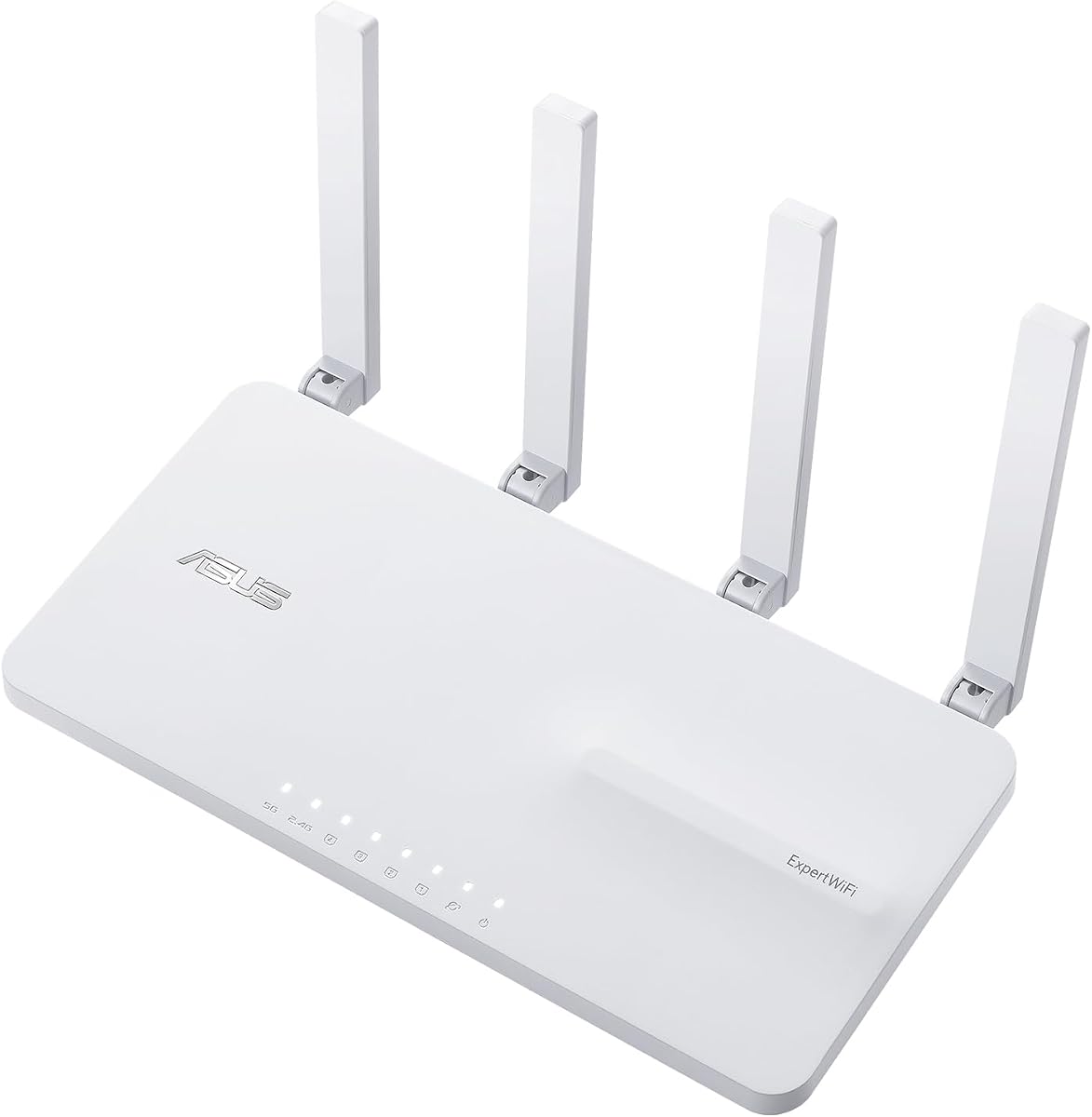
The ASUS ExpertWiFi EBR63 stands out as a top choice for businesses needing reliable connectivity with strong security. It holds a 4.2 star rating from verified purchasers who appreciate its robust feature set and ease of use in commercial settings.
We may earn a commission when you buy through this link, at no additional cost to you.
This router supports up to five SSIDs allowing you to separate guest traffic from internal business operations. The customizable guest portal lets you tailor the branding and access flow to match your company identity. AiProtection Pro provides enterprise-grade threat protection at no extra cost.
While the AX3000 standard is sufficient for most offices it may not suit high-density environments requiring maximum throughput. The USB port for backup WAN adds reliability but depends on mobile hotspot availability for failover scenarios.
Businesses needing secure segregated networks should consider this router for its balance of features and management ease. It fits well in small to mid-sized offices where security and guest handling are priorities alongside daily operations.
Up to five SSIDs let you isolate devices for different scenarios such as guest access IoT and secure staff networks.
The all-in-one ExpertWiFi app provides remote management and quick setup without requiring complex hardware controllers.
We may earn a commission when you buy through this link, at no additional cost to you.
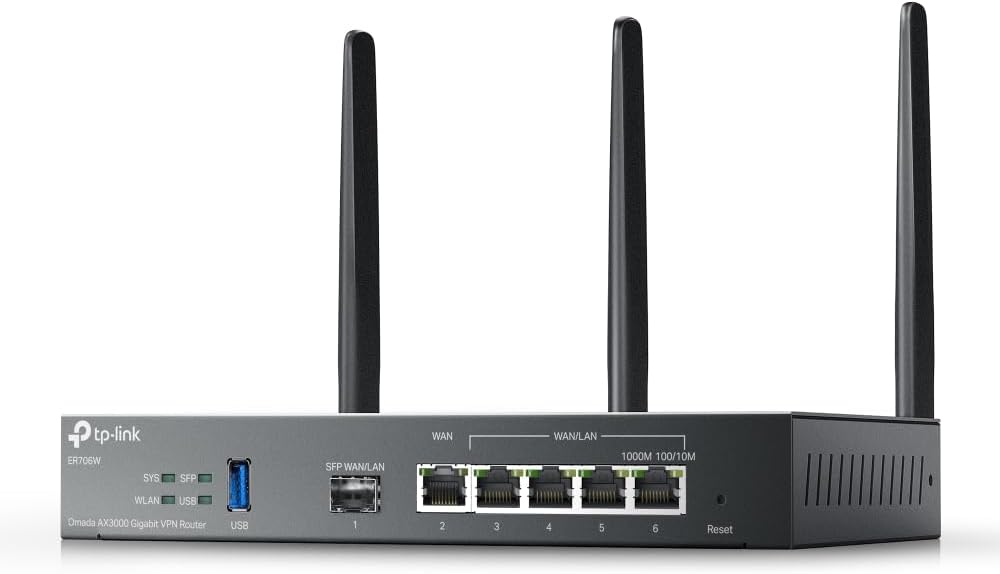
The Omada ER706W is designed for businesses that need flexible internet connections and robust VPN capabilities. With a 4.1 star rating it delivers solid performance for small offices relying on multiple ISP lines or secure remote access.
We may earn a commission when you buy through this link, at no additional cost to you.
Its five Gigabit RJ45 ports and one SFP slot support diverse connectivity options including fiber and copper. Load balancing across up to five WAN ports ensures optimal bandwidth use and redundancy during peak usage times.
The router integrates seamlessly with Omada access points to extend wireless coverage but requires a controller for advanced features. While secure it lacks the newer WiFi 7 capabilities found in higher-end models.
IT managers seeking versatile connectivity and strong VPN support will find this router suitable for secure office networks. It balances cost and functionality for businesses needing reliable multi-line internet management.
One SFP slot plus five RJ45 ports provide flexibility for fiber or copper connections in varied office setups.
High-security SSL IPSec GRE WireGuard and L2TP protocols enable secure remote access for business teams.
We may earn a commission when you buy through this link, at no additional cost to you.
The Ruckus R750 is engineered for environments where many devices connect simultaneously such as conference centers or lecture halls. It achieves a 4.3 star rating due to its exceptional ability to maintain performance in crowded wireless conditions.
We may earn a commission when you buy through this link, at no additional cost to you.
This access point uses smart antenna technology to direct signals efficiently reducing interference and improving throughput. It supports modern WiFi 6 standards ensuring compatibility with the latest devices while maximizing network capacity.
As an access point it must be paired with a router to provide internet access which adds complexity to the setup. Its higher price reflects its specialized design for high-density scenarios rather than general office use.
Organizations needing reliable coverage in packed spaces should choose this access point for its capacity and signal optimization. It is ideal for schools hospitals or hotels where consistent connectivity is critical.
BeamFlex+ adaptive antennas maximize signal coverage and minimize errors for consistent performance in dense areas.
Built specifically for ultra-dense environments it handles many simultaneous connections without significant slowdowns.
We may earn a commission when you buy through this link, at no additional cost to you.
The Ruckus R670 brings WiFi 7 capabilities to mainstream business environments with impressive data rates. It offers exceptional performance for meeting rooms and classrooms where multiple high-bandwidth devices operate at once.
We may earn a commission when you buy through this link, at no additional cost to you.
With built-in spatial streams and adaptive antenna technology it maximizes signal coverage and throughput. It also supports BLE and Zigbee to unify wireless technologies into a single network for broader device integration.
The premium price point may be prohibitive for smaller setups but justifies itself in high-traffic areas needing top performance. Management options include on-premise appliances for streamlined deployment across larger sites.
Enterprises deploying next-generation WiFi should consider this access point for its advanced features and unified network support. It fits well in larger campuses where future-proofing is essential.
Provides exceptional end-user experience expanding use cases for Wi-Fi 7 in guest rooms and classrooms.
Eliminate siloed networks by unifying Wi-Fi and non Wi-Fi wireless technologies into one single network.
We may earn a commission when you buy through this link, at no additional cost to you.
The NETGEAR Orbi 970 Series delivers top-tier performance with WiFi 7 technology and impressive speed capabilities. It holds a 4.6 star rating for its ability to cover large spaces with consistent high-speed wireless connectivity.
We may earn a commission when you buy through this link, at no additional cost to you.
Exclusive Quad-Band technology with Dedicated Backhaul ensures fast connections even when many devices are active. The system includes a 10 Gig internet port and multiple fast LAN ports for reliable wired links to key devices.
While designed for large homes the mesh system can also support extensive commercial spaces needing seamless coverage. Its high price and extensive feature set make it more suitable for large organizations than small offices.
Businesses requiring vast coverage and top speed should consider this system for its capacity and dedicated backhaul. It is ideal for large facilities where dead zones must be eliminated completely.
Quad-Band technology reserves a dedicated lane for satellite traffic so WiFi stays fast on every device.
A 10 Gig internet port plus 10 Gig LAN ports deliver ultra-fast wired connections for gaming and office.
We may earn a commission when you buy through this link, at no additional cost to you.
The Omada EAP650 offers high-speed WiFi 6 performance at an accessible price point for small businesses. Its 4.5 star rating reflects satisfaction with its design and reliable wireless coverage in various settings.
We may earn a commission when you buy through this link, at no additional cost to you.
With true Wi-Fi 6 speeds up to 2976 Mbps it handles multiple devices effectively. The ultra-slim design ensures simple installation while saving space and blending into modern offices or classrooms.
It supports seamless roaming when integrated with Omada SDN controllers but stands alone for basic use cases. The included cloud management allows remote control without needing extra hardware controllers.
Businesses needing affordable high-performance access points should consider this model for its balance of features and simplicity. It suits cafes or schools where cost efficiency and clean installation matter.
Boasts dual-band Wi-Fi speeds up to 2976 Mbps with advanced Wi-Fi 6 technology like 1024-QAM.
EAP650 supports 802.3at PoE plus Passive PoE and DC power supply for versatile deployment options.
We may earn a commission when you buy through this link, at no additional cost to you.
The Ubiquiti U6+ is a professional-grade access point offering reliable connectivity with high-speed data transfer. It earns a 4.6 star rating for its consistent performance and ease of integration into UniFi networks.
We may earn a commission when you buy through this link, at no additional cost to you.
Its 3 Gbit/s transmission speed ensures efficient communication for busy environments. The PoE+ port allows data and power over a single cable which simplifies installation in areas without power outlets.
Wall-mountable design ensures maximum comfort and pain-free usage while maintaining aesthetics. Data encryption protects valuable business information from unauthorized access enhancing overall network security.
IT teams needing a reliable professional access point should choose this for its efficiency and power options. It suits offices and retail spaces where clean installation and speed are priorities.
PoE+ port receives data and power up to 25.5W through a single cable where outlets are unavailable.
3 Gbit/s wireless speed provides high and efficient communication with maximum efficiency for devices.
We may earn a commission when you buy through this link, at no additional cost to you.
The TP-Link BE6500 router offers future-ready WiFi 7 capabilities with Multi-Link Operation for optimized performance. It holds a 4.3 star rating for delivering faster speeds and improved reliability for modern devices.
We may earn a commission when you buy through this link, at no additional cost to you.
Achieving speeds up to 6.5 Gbps across dual bands it supports demanding applications like 4K streaming. The 2.5 Gbps WAN/LAN ports allow integration with multi-gig internet plans for faster wired connections.
While it supports EasyMesh for expansion it is not compatible with Deco systems which limits mesh flexibility. Security is handled via HomeShield providing real-time IoT security and parental controls without extra fees.
Businesses upgrading to WiFi 7 should consider this router for its speed and secure design. It fits well in offices needing future-proof speeds without high-end costs.
Simultaneously transfers data across frequency bands delivering enhanced throughput lower latency and improved reliability.
A 2.5 Gbps WAN/LAN port offers high-speed data transmissions for multi-gig internet integration.
We may earn a commission when you buy through this link, at no additional cost to you.
The NETGEAR Nighthawk WiFi 7 router provides dedicated tri-band performance to keep up with busy homes or offices. It achieves a 4.3 star rating for reliable connections across various devices and streaming needs.
We may earn a commission when you buy through this link, at no additional cost to you.
With up to 9.3 Gbps across bands it ensures the fastest devices get their own lane to prevent slowdowns. The 2.5 Gig WAN port unlocks multi-gig internet plans for faster wired connections to key devices.
Its coverage reaches up to 2500 sq ft making it suitable for medium-large commercial spaces. Active internet is required for the app setup but ongoing management remains convenient for remote users.
Businesses needing high throughput and easy management should consider this router for its speed and features. It fits well where many users connect simultaneously without performance drops.
A third high-speed band for demanding devices keeps up as your connected home grows with streaming.
Plug your modem into the 2.5 Gig WAN port to unlock multi-gig internet plans for faster access.
We may earn a commission when you buy through this link, at no additional cost to you.
The ASUS RT-BE88U router delivers blazing-fast WiFi 7 performance with dual 10G ports for massive bandwidth. It holds a 4.3 star rating for its powerful processor and robust feature set for demanding networks.
We may earn a commission when you buy through this link, at no additional cost to you.
It supports Multi-Link Operation and 4096-QAM to boost throughput up to 7200Mbps. The two 10G ports include one SFP+ and one WAN/LAN ensuring capacity for heavy data transfer needs.
AI WAN detection ensures always-on internet by versatile WAN options and mobile tethering. AiMesh support allows seamless whole-home network expansion without replacing existing compatible hardware.
Large offices needing extreme wired capacity should consider this router for its dual 10G and fast WiFi. It suits environments where data throughput and reliability are critical daily priorities.
Bolster your wired network capacity up to 34G with one 10G SFP+ and one 10G WAN/LAN port.
Ensure seamless connectivity for all devices with a feature-rich whole-home network powered by AiMesh.
We may earn a commission when you buy through this link, at no additional cost to you.
Selecting the right commercial wireless router requires evaluating multiple technical and operational factors to ensure it meets your business needs.
Wireless standards like WiFi 6 or WiFi 7 determine maximum speed and device capacity. WiFi 7 offers faster speeds and lower latency but may require compatible client devices to fully benefit.
Look for routers with built-in firewall, intrusion prevention, and secure guest networks. Commercial-grade routers often include enterprise security suites to protect sensitive data from threats.
A user-friendly dashboard or mobile app simplifies setup and monitoring. Some systems offer cloud management for remote control across multiple locations without hardware controllers.
Check for sufficient LAN and WAN ports including high-speed options like 2.5G or 10G. SFP slots may be needed for fiber internet connections in commercial environments.
Ensure the router supports adding access points or extending coverage via mesh technology. Scalable systems allow growth without replacing core networking hardware as business expands.
Secure remote access for employees often requires built-in VPN capabilities. Check supported protocols like IPSec or OpenVPN for compatibility with existing security setups.
Backup WAN options such as USB tethering ensure uptime during primary internet failures. Load balancing across multiple ISPs can also maintain performance during peak usage.
Business-grade equipment typically comes with extended warranties and dedicated technical support. Reliable support minimizes downtime if issues arise during network operations.
Begin by connecting the router to your modem using an Ethernet cable and powering it on. Access the setup interface via a web browser or mobile app to configure network settings and SSIDs.
Update firmware regularly through the management dashboard to ensure security patches and new features are applied. Regular updates also maintain compatibility with evolving client devices and standards.
Place the router in a central elevated location away from obstructions to optimize signal distribution. Periodic reboots and performance checks help maintain consistent connectivity for all users.
Commercial routers offer enhanced security, multiple SSIDs for guest and staff separation, and robust management tools. They often support higher device counts and include enterprise protocols like VLANs and advanced VPNs.
Yes, most commercial routers require a separate modem or gateway to connect to the internet. Some models include SFP slots for fiber connections, but typically you need a modem to receive the ISP signal.
Many models allow multiple SSIDs and guest portals to isolate guest traffic from internal networks. This enhances security by preventing external users from accessing business resources directly.
Multi-Link Operation lets devices use multiple frequency bands simultaneously for faster speeds and lower latency. It improves performance by aggregating bandwidth across channels for more reliable connections.
Use compatible mesh systems or add access points to extend coverage without replacing the main router. Many commercial setups support mesh protocols for seamless roaming across larger spaces.
Some require more configuration due to enterprise features like VLANs or multiple WANs. However, many include apps or wizards to simplify setup for small business owners without IT expertise.
The ASUS ExpertWiFi EBR63 stands out for balanced features and security, while the TP-Link BE6500 offers future-ready WiFi 7 at a lower cost. For maximum performance and coverage, the NETGEAR Orbi 970 provides top-tier speed and mesh capabilities.
Prioritize security, management ease, and connectivity options based on your business size. Ensure the router supports necessary protocols like VPNs and multiple SSIDs to handle diverse device needs effectively.
Prices and availability may shift so confirm current details before purchasing. Evaluate each model's fit for your specific environment to ensure long-term reliability and performance for your network.