
LAFVIN R3 Camera Smart Robot Car
4.5Editor score
Affordable price point
Built-in ESP32-S3 Wi-Fi module
Five intelligent operation modes
This guide compares the top Arduino robot kits for kids and adults, evaluating features, ease of assembly, programming options, and educational value to help
Arduino robot kits offer an engaging way to learn coding and electronics through hands-on building. These kits transform theoretical concepts into physical machines that can move, sense, and interact with the world around them.
We compared ten leading kits based on assembly complexity, sensor variety, programming flexibility, and build quality. Our analysis focuses on educational value, expandability, and suitability for different age groups and skill levels.
Each pick highlights specific strengths and trade-offs to help you find the right fit for your projects. Keep in mind that pricing and availability can change, so verify current details before making a purchase decision.
4.5Editor score

4.5Editor score

4.3Editor score
This side-by-side comparison highlights the core specifications and unique features of each kit to help you quickly identify which model aligns best with your learning goals and project ambitions.


The ELEGOO UNO R3 Smart Robot Car Kit V4 is a top-rated choice for anyone wanting a complete robotics experience. It combines solid build quality with modern features like Wi-Fi streaming and a rechargeable power system.
We may earn a commission when you buy through this link, at no additional cost to you.
This kit stands out for its guided wiring system that uses keyed connectors to minimize mistakes during assembly. The included ESP32 camera module allows users to stream live FPV video, which adds a layer of immersion often missing from basic kits.
While the kit offers extensive capabilities, the assembly process is thorough and may require patience for first-time builders. Additionally the camera angle is adjustable via servo but the base mount is not fully customizable without modification.
This kit is ideal for families or students ready to dive into coding and electronics. The balance of hardware quality and software resources makes it a reliable foundation for learning Arduino programming and robotics logic.
The onboard camera allows you to view the robot perspective in real time through your phone, making navigation more intuitive and engaging.
Keyed XH2.54 connectors prevent incorrect wiring, ensuring that beginners can assemble the hardware without frustrating short circuits or connection errors.
We may earn a commission when you buy through this link, at no additional cost to you.
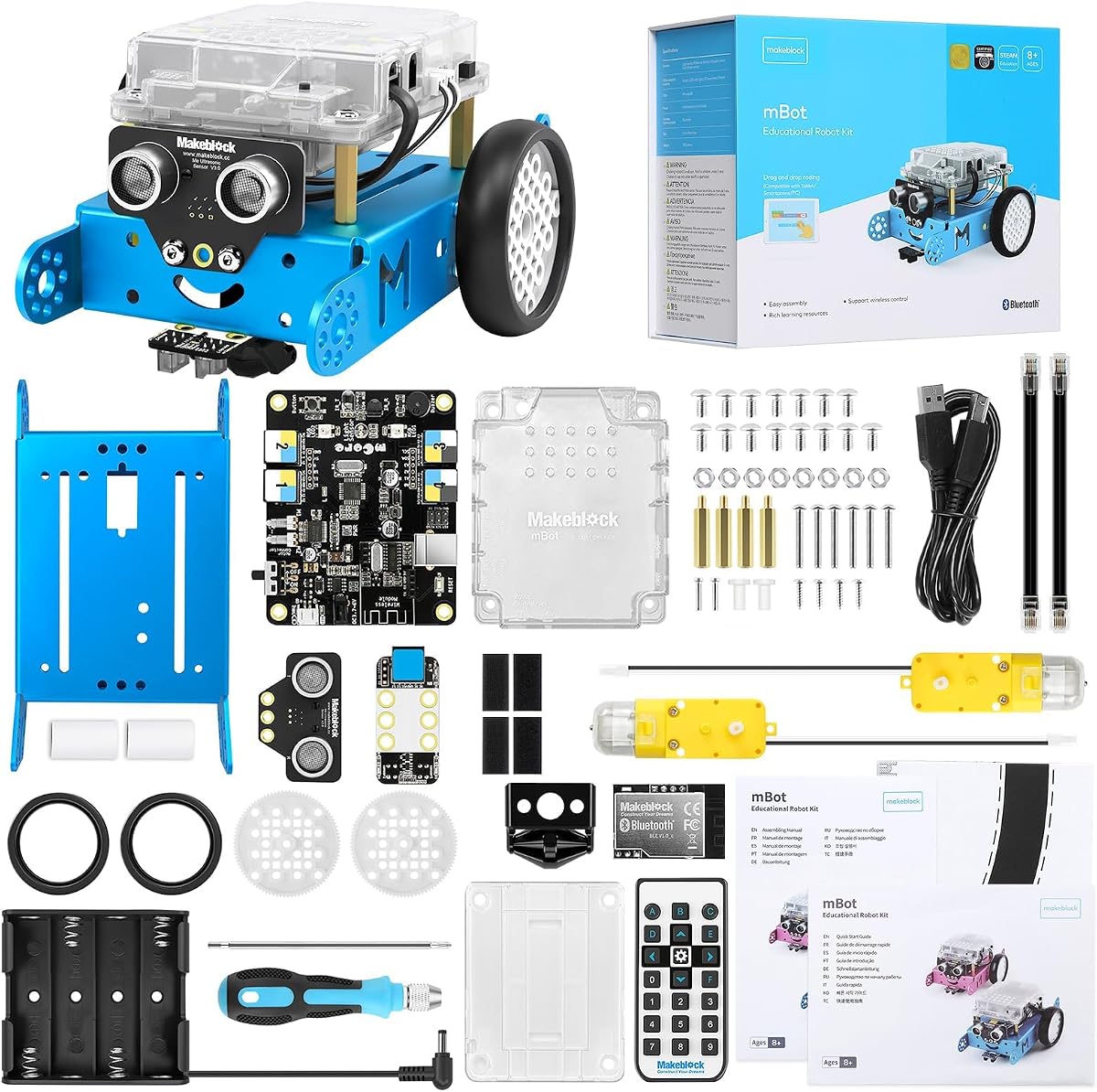
The Makeblock mBot is designed specifically for children aged eight to twelve, offering an entry-level approach to robotics. It simplifies the learning curve by allowing kids to start with visual block coding before moving to text.
We may earn a commission when you buy through this link, at no additional cost to you.
Its standout feature is the quick assembly time which typically takes just fifteen minutes. The kit uses clear instructions and robust metal components that withstand active play. It also integrates with LEGO parts for expanded creativity.
On the downside the kit requires AA batteries that are not included in the box. The sensor set is also limited compared to more advanced models, which may constrain complex project possibilities for older students.
This kit is perfect for introducing young children to robotics in a fun way. The combination of fast setup and gradual coding progression helps maintain interest and builds confidence in programming concepts.
Students begin with drag-and-drop blocks and later graduate to Arduino IDE code, creating a smooth learning path that grows with their skills.
The modular design allows attachment to standard LEGO bricks, enabling kids to customize the robot with additional creative structures.
We may earn a commission when you buy through this link, at no additional cost to you.
The ELEGOO Conqueror brings a tank-style platform to Arduino robotics. It focuses on durability and terrain navigation with a stainless steel chassis and tracks that handle varied surfaces better than standard wheels.
We may earn a commission when you buy through this link, at no additional cost to you.
A key benefit is the adjustable camera mounted on a servo which lets you change the viewing angle during operation. This adds practical value for inspection or patrol scenarios. The kit also includes five interactive modes.
However the tank design makes the robot heavier and larger than typical car kits. This may limit portability and indoor use space. Assembly is straightforward but takes longer due to track alignment.
Choose this kit if you want a rugged robot that can handle rougher environments. The combination of metal construction and flexible camera control makes it ideal for outdoor or obstacle-heavy challenges.
The tank tracks provide superior traction on uneven surfaces like carpet or grass where wheels might slip or get stuck.
A servo-controlled camera mount allows dynamic viewing angles, improving usability during navigation or remote exploration tasks.
We may earn a commission when you buy through this link, at no additional cost to you.
The ELEGOO Tumbller is a two-wheel robot that maintains upright balance using real-time motor control. It teaches fundamental concepts of motion sensing and feedback loops in a tangible way.
We may earn a commission when you buy through this link, at no additional cost to you.
This robot offers six different ways to play including bounce mode and auto-follow. The LED effects add visual appeal and provide status feedback during operation. The guided tutorial ensures beginners understand the wiring and logic.
The main challenge is that balance depends on flat surfaces and proper calibration. Uneven floors can cause tipping or unstable driving. Users may need to adjust parameters to find the sweet spot for stable operation.
Ideal for students interested in control systems this kit transforms abstract math into physical motion. The balance challenge is engaging and rewards persistent tuning with smooth performance.
By using sensors to detect tilt and adjusting motor speed instantly the robot demonstrates closed-loop control in real time.
LEDs signal status changes and modes providing immediate visual cues that help users understand robot states.
We may earn a commission when you buy through this link, at no additional cost to you.
The ACEBOTT smart car uses Mecanum wheels that allow movement in any direction including sideways and diagonal. This capability expands navigation options significantly compared to standard forward and backward movement.
We may earn a commission when you buy through this link, at no additional cost to you.
The kit supports multiple control methods including an app and IR remote. Expansion packs for cameras or robotic arms provide future growth. Multi-directional obstacle avoidance helps the car react flexibly to surroundings.
One challenge is that Mecanum wheels require precise calibration and surface conditions to perform correctly. Additionally batteries are not included so you must source compatible cells separately before use.
This kit suits users who want advanced navigation and expansion. The ability to drift and rotate in place adds a fun dimension to driving and robotics experiments.
Omnidirectional wheels enable strafing and rotation without turning the car body allowing for advanced maneuverability in tight spaces.
The platform supports multiple expansion packs including robotic arms and cameras enabling continuous project evolution over time.
We may earn a commission when you buy through this link, at no additional cost to you.
The LAFVIN R3 offers a low-cost entry into smart robot cars with a built-in Wi-Fi module. It provides FPV streaming and multiple modes at a price point that is hard to beat for beginners.
We may earn a commission when you buy through this link, at no additional cost to you.
This kit uses the ESP32-S3 module which supports wireless control and video transmission. The open-source ecosystem provides free tutorials and code resources to support learning and customization.
The main trade-off is that full self-assembly is required which can be daunting for some. The camera hardware is basic compared to premium kits but sufficient for introductory video experiments.
This is the best choice for budget-conscious users who want Wi-Fi capabilities. It delivers essential features and learning support without a high price tag.
Built-in ESP32-S3 enables real-time video streaming and remote control via mobile devices without extra hardware.
Free online tutorials and code libraries help users learn quickly and adapt the robot for new projects.
We may earn a commission when you buy through this link, at no additional cost to you.
The ACEBOTT 4-in-1 kit enables users to build a base car tank track expansion and a 5DOF robotic arm. This modularity encourages experimentation with different mechanical forms and functions.
We may earn a commission when you buy through this link, at no additional cost to you.
The robotic arm lets users practice precise motion control and logic. Tank tracks ensure rugged movement. HD videos guide assembly step by step making complex builds more manageable.
While versatile this kit has a lower rating likely due to build complexity and integration challenges. Users should expect to invest significant time mastering all four configurations.
Choose this if you want variety in a single box. It suits older teens ready for challenging builds and long-term projects.
Switch between car and tank with robotic arm attachment to explore diverse mechanical principles and functions.
The programmable arm teaches precise motor control and kinematics essential for advanced robotics applications.
We may earn a commission when you buy through this link, at no additional cost to you.
The SunFounder Ultimate Starter Kit is a comprehensive bundle with 192 items across 87 projects. It covers everything from basic LEDs to IoT applications and smart cars.
We may earn a commission when you buy through this link, at no additional cost to you.
Courses by Circuit Basics provide step-by-step video instruction. The breadth of content ensures long-term engagement. Users gain exposure to sensors actuators and connectivity in a structured path.
The large component list can feel overwhelming for some. Organizing parts and following many steps requires patience. Still the educational payoff is high.
Ideal for self-learners wanting a complete toolkit this kit supports growth from beginner to intermediate levels effectively.
With 87 projects users can explore diverse topics including IoT and robotics without needing extra components.
Expert-designed video tutorials ensure clear guidance and help users build confidence through incremental learning.
We may earn a commission when you buy through this link, at no additional cost to you.
The Makeblock mBot Ultimate delivers a premium experience with industrial-grade aluminum parts and ten build options. It is built for durability and long-term projects.
We may earn a commission when you buy through this link, at no additional cost to you.
The MegaPi control board supports multiple motors and advanced sensors. Compatibility with Raspberry Pi allows for machine vision and Python coding. This makes the kit highly scalable.
The price is higher than other kits and batteries are not included. However the component quality and flexibility justify the cost for serious learners.
Best for users wanting a long-term platform this kit grows with skills and supports professional-grade projects.
Upgrade to Raspberry Pi or advanced sensors for machine vision and complex automation projects.
High-strength aluminum alloy parts ensure durability and precision for long-lasting models.
We may earn a commission when you buy through this link, at no additional cost to you.
The Freenove Hexapod robot features six legs with three motors each allowing complex walking and twisting motions. It is a unique take on standard wheeled kits.
We may earn a commission when you buy through this link, at no additional cost to you.
Users can control the robot via remote or app. A prewritten code library simplifies motion programming. Instructions are digital only which may be inconvenient for some.
Tuning gait patterns can be challenging. Digital-only docs require tech access. However the novelty of a walking robot offers rich learning in kinematics.
Perfect for users wanting something beyond wheels this kit offers distinctive motion control and creative possibilities.
Independent control of 18 servos allows intricate leg movements for walking and crawling on varied surfaces.
Multiple control options via included remote or mobile apps increase convenience during testing and play.
We may earn a commission when you buy through this link, at no additional cost to you.
Selecting the right robot kit depends on your skill level project goals and budget. This guide breaks down key factors to help you make an informed choice.
Choose a kit that matches the builder's age and technical background. Younger users benefit from visual coding and simpler assembly while older teens can handle text-based Arduino IDE programming.
Always verify the recommended age range in product descriptions to ensure the tasks and concepts are appropriate.
Some kits require soldering or complex wiring while others use plug-and-play connectors. Consider your patience and experience with electronics tools before starting a project.
Prefer kits with keyed connectors and illustrated tutorials if you want to avoid frustration during build time.
Look for kits that include ultrasonic distance sensors line tracking modules or cameras. These features expand what your robot can do and improve learning outcomes.
More sensors mean more project possibilities so prioritize kits with diverse input options for long-term engagement.
Ensure the kit supports the coding environments you want to use. Many kits allow progression from block-based to text-based languages which is ideal for growing skills.
Check compatibility with popular tools like Arduino IDE and Scratch to keep learning resources accessible and free.
Power requirements vary widely between kits. Some include rechargeable batteries while others need disposable cells not included in the box.
Opt for rechargeable power to reduce ongoing costs and ensure consistent performance during extended use sessions.
A modular design allows you to add extra parts like robotic arms or tracks later. This flexibility extends the life of your kit and encourages creativity.
Select a platform that supports add-on packs or third-party components to grow your projects over time.
Strong documentation online tutorials and active forums help troubleshoot issues quickly. Look for brands that provide free code libraries and HD videos.
Community support ensures you can find answers and inspiration when you get stuck or want new project ideas.
Robust materials like metal chassis or aluminum parts withstand repeated use better than plastic. Durability matters for long-term learning and outdoor testing.
Prioritize kits with quality parts to avoid breakage and ensure your robot lasts through many projects.
Assemble the robot following the provided guide and check all connections before powering on. Use keyed connectors to prevent miswiring and ensure each component is secure.
Install batteries or charge the power pack as recommended and test each function via the included app or remote. Start with simple movements before advancing to complex routines.
Store the robot and parts in a dry safe place when not in use. Keep spare screws and tools organized to avoid losing components during future assembly or modification.
Most kits are designed for ages eight and up but some advanced models target teens and adults. Check the product details for specific age recommendations. Younger children may need adult supervision.
Many kits provide block-based coding options so no prior experience is needed. As you progress you can learn text-based languages. Tutorials guide you through each step to build confidence.
Yes most kits are open source and allow code modification. You can add custom behaviors or integrate additional sensors. This flexibility encourages creativity and deeper learning.
Some kits include rechargeable batteries while others do not. Always verify the component list before purchasing. Rechargeable power is convenient and cost-effective for regular use.
Most kits work with the free Arduino IDE or mobile apps for visual coding. Some support additional tools like Scratch. Check compatibility with your preferred environment before buying.
Keep wheels and tracks clean and tighten screws periodically. Avoid wet environments unless the robot is weather rated. Proper storage extends the life of components and electronics.
Yes many educators use these kits for STEM classes and science fairs. They provide hands-on learning for engineering and coding concepts. Tutorials help students complete assignments.
Most products offer online video tutorials and community support. Review these resources before contacting manufacturer support. Many brands provide step-by-step guides for each assembly phase.
This guide reviewed ten top Arduino robot kits ranging from budget-friendly cars to premium modular builds. Each offers unique strengths for different ages skill levels and project goals.
Prioritize kits that match your current expertise and future learning ambitions. Consider features like FPV cameras tank tracks or robotic arms to align with your interests.
Remember that availability and pricing can change so always check current details on the retailer site. Investing in the right kit today sets you up for successful and enjoyable building experiences.