
Celestron 114LCM
4.2Editor score
Computerized GoTo
Complete accessory kit
Beginner friendly
Computerized telescopes transform night sky exploration by automatically locating and tracking celestial objects. These modern instruments combine powerful optics with smart software to make astronomy accessible for enthusiasts of all skill levels.
We evaluated ten leading models based on optical quality, mount stability, ease of alignment, and overall user experience. Each telescope was assessed for its ability to deliver clear views while maintaining portability and value for money.
Every selection highlights specific strengths like aperture size, software features, or specialized mounts. Keep in mind that product availability and pricing change frequently, so verify details before making your final purchase decision.
4.2Editor score

4.3Editor score

4.4Editor score
As an Amazon Associate we earn from qualifying purchases.
The following table provides a side-by-side overview of key specifications and features across all ten selected computerized telescopes to help you quickly identify the model that fits your specific observing goals.




The Celestron NexStar 8SE stands out as a top choice for adult observers seeking a balance between power and portability. With its impressive four point three star rating, it delivers reliable performance for both planetary and deep sky viewing.
We may earn a commission when you buy through this link, at no additional cost to you.
Its eight inch Schmidt Cassegrain optics gather ample light to reveal fine lunar details and distant galaxies. The fully automated GoTo system with over forty thousand objects ensures you never lose track of your target while SkyAlign technology simplifies setup.
While the scope requires an external power source and some initial assembly, these trade-offs are minimal compared to the viewing quality. The integrated wedge allows for future astrophotography upgrades as your skills develop over time.
This telescope is ideal for serious hobbyists who want high quality views without a permanent observatory setup. It remains a trusted recommendation for those ready to step up from manual scopes to computerized precision.
The large aperture allows detailed views of Saturn rings and nebulae even under moderately light polluted skies.
The SkyAlign feature reduces setup time significantly by allowing alignment with any three bright stars.
We may earn a commission when you buy through this link, at no additional cost to you.
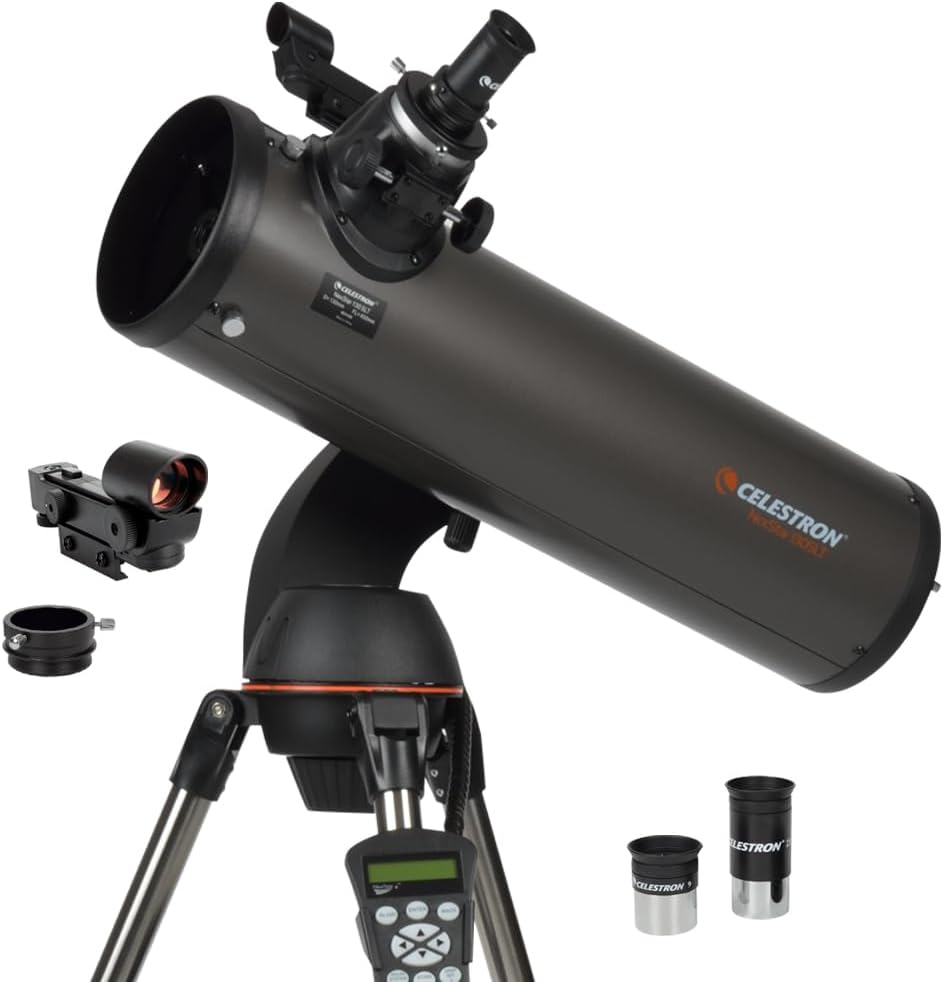
The NexStar 130SLT offers an excellent entry point into computerized astronomy with a highly rated four point four star average. Its compact design makes it perfect for weekend trips to dark sky sites or casual backyard observing.
We may earn a commission when you buy through this link, at no additional cost to you.
Featuring a one thirty millimeter Newtonian reflector, this scope gathers enough light to see Saturn rings and Jupiter bands clearly. The included Starry Night software enhances the experience by helping users plan sessions and simulate the sky.
While the aperture is smaller than premium models, it remains sufficient for most beginners. The main compromise is tripod stability which may require gentle handling during focusing adjustments in windy conditions.
This model is best suited for families or casual observers who prioritize portability. It provides a smooth introduction to GoTo technology without breaking the budget or demanding heavy lifting.
The lightweight design allows easy transport to camping sites and simple assembly in minutes.
Free software downloads help new users learn constellations and plan observing sessions effectively.
We may earn a commission when you buy through this link, at no additional cost to you.
With a four point four star rating, the NexStar 5SE bridges the gap between beginner and advanced scopes. Its five inch aperture delivers sharp planetary views while maintaining a footprint small enough for travel.
We may earn a commission when you buy through this link, at no additional cost to you.
The built in wedge is a unique feature allowing polar alignment for astrophotography without extra costs. The fully automated GoTo system ensures precise tracking, making it simple to enjoy deep sky targets after dark.
The trade off is reduced light gathering compared to larger scopes. Faint galaxies may appear dimmer, but planetary detail remains excellent. This makes it ideal for travelers who value convenience alongside image quality.
Buyers seeking a portable scope capable of future imaging should consider this model. It balances performance and size effectively, offering a solid upgrade path for those outgrowing smaller instruments.
The integrated wedge enables basic imaging setups for those interested in long exposure photography.
The compact form factor allows easy transport and setup in remote locations or small yards.
We may earn a commission when you buy through this link, at no additional cost to you.
The 114LCM holds a four point two star rating and serves as an accessible entry point for new observers. It includes all necessary components like eyepieces and a finderscope, removing the need for extra purchases.
We may earn a commission when you buy through this link, at no additional cost to you.
The Sky Tour button automatically selects the best visible objects, which is helpful for unsure users. The GoTo mount locates targets accurately while the included software helps plan future sessions from any location.
Limited aperture means fainter objects may be hard to see and the tripod can shake in wind. However, these are expected trade-offs at this price point for a fully automated telescope.
This is the smart choice for budget conscious beginners who want automation without complexity. It provides a complete package that makes the first steps into astronomy enjoyable and frustration free.
The all-in-one package ensures users start observing immediately without additional accessory purchases.
The automated Sky Tour suggests viewing targets based on current conditions and location.
We may earn a commission when you buy through this link, at no additional cost to you.
Featuring a four point two star rating, the 127SLT excels in contrast and sharpness thanks to its Maksutov Cassegrain optics. The closed tube design minimizes dust and reduces maintenance requirements for users.
We may earn a commission when you buy through this link, at no additional cost to you.
Planetary objects like Jupiter bands and Saturn rings appear crisp and well defined. The SkyAlign procedure ensures quick setup while the included Starry Night software adds value for educational planning.
The main drawback is the longer cool down time due to thermal mass. Deep sky objects appear dimmer than in larger reflectors but this is acceptable given the optical clarity and portability.
This model suits observers prioritizing sharp lunar and planetary detail over faint deep sky objects. It is an excellent lightweight travel scope for those who value optical quality and ease of use.
The Maksutov design delivers superior contrast for observing planets and lunar features clearly.
The sealed tube prevents dust accumulation and reduces the need for frequent optical cleaning.
We may earn a commission when you buy through this link, at no additional cost to you.
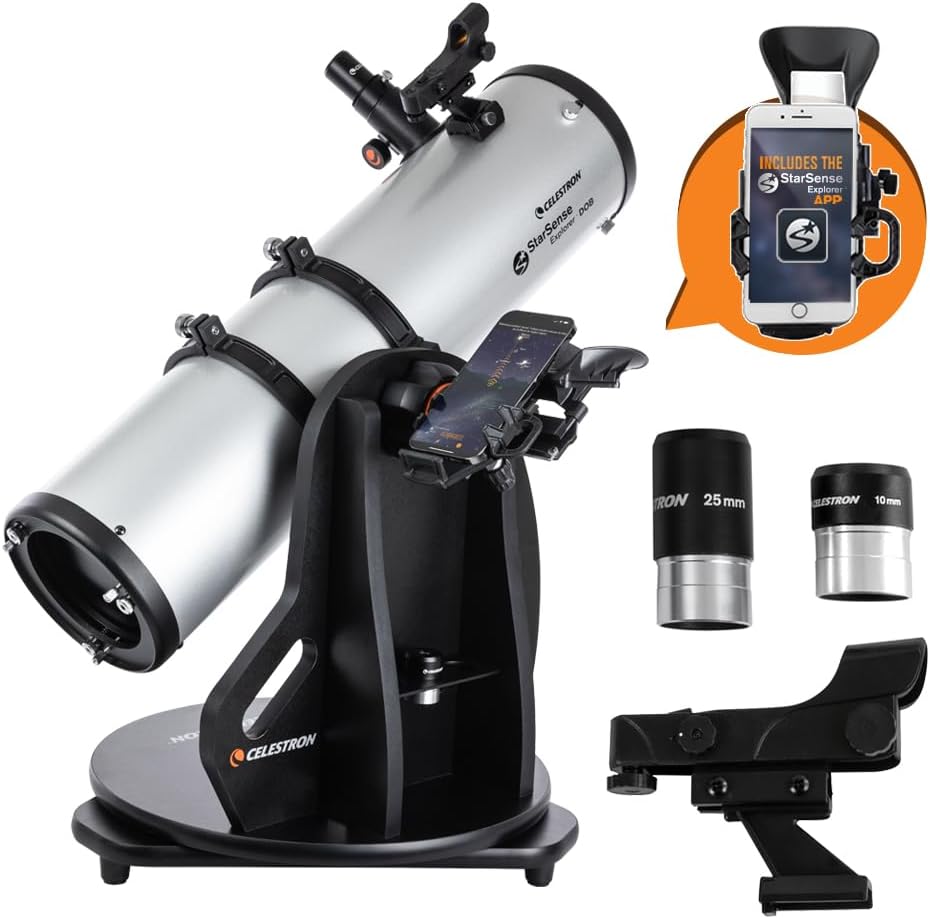
The StarSense Explorer holds a four point three star rating and introduces smartphone powered astronomy. By docking your phone and using the app, you can locate stars without needing complex manual adjustments.
We may earn a commission when you buy through this link, at no additional cost to you.
Patented sky recognition technology identifies star patterns to align the scope instantly. The tabletop Dobsonian base offers smooth tracking and supports a one fifty millimeter reflector for vivid views of planets and nebulae.
The reliance on smartphone battery life may limit extended sessions unless backup power is available. Also the tabletop height might be less comfortable for tall users without additional seating.
This is perfect for casual observers wanting a tech savvy experience. It simplifies star finding to just following arrows on a screen making astronomy accessible to anyone with a smartphone.
The app uses camera vision to align the scope automatically using overhead star patterns.
Follow on screen arrows to targets ensuring even beginners can find objects quickly.
We may earn a commission when you buy through this link, at no additional cost to you.
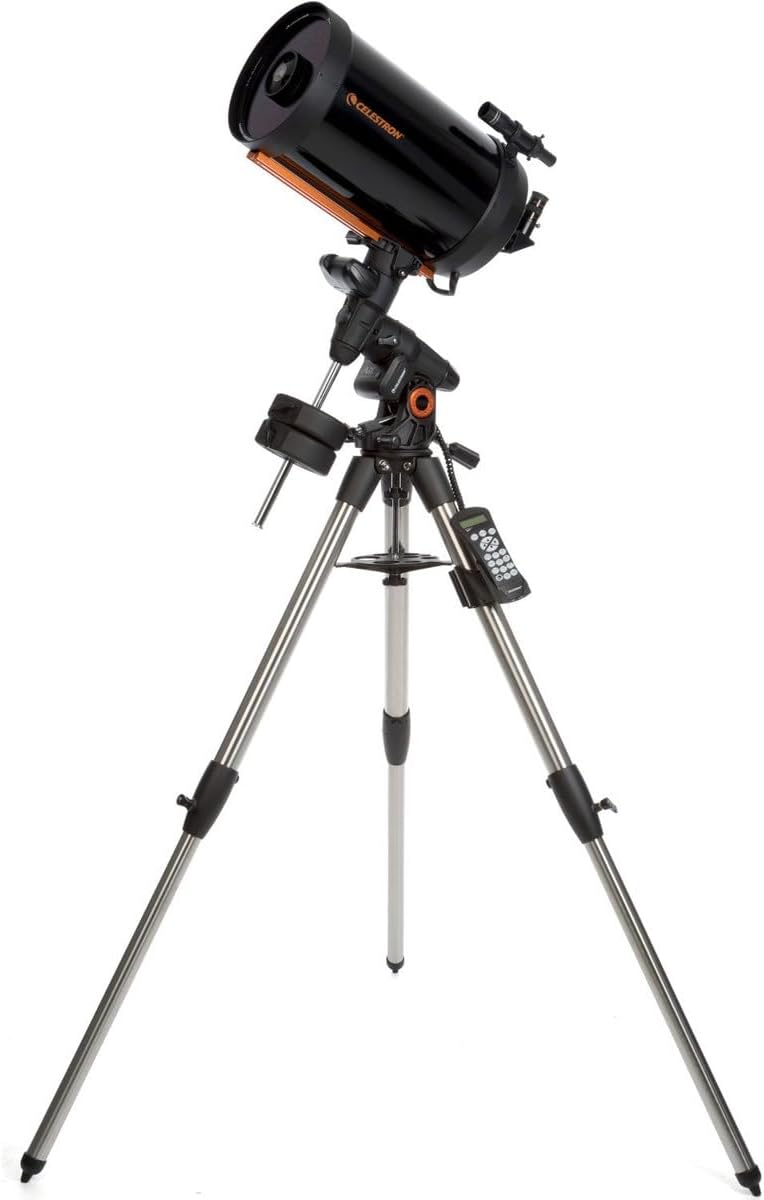
Rated four point two stars, the Advanced VX 8 combines powerful optics with a German Equatorial mount for advanced tracking. The StarBright XLT coatings enhance contrast allowing detailed views of celestial objects.
We may earn a commission when you buy through this link, at no additional cost to you.
The mount supports up to thirty pounds ensuring stability during long sessions. With a two hundred three two millimeter focal length you can achieve magnifications up to four eight zero with optional eyepieces.
The trade-off is the complexity of polar alignment which demands more time to setup than alt az mounts. The added weight also makes transportation more challenging for casual observers.
This scope is ideal for users focused on astrophotography or precise tracking needs. The stability and mount quality provide a platform that grows with advanced imaging skills over time.
The heavy duty tripod and EQ mount provide vibration free tracking essential for imaging.
StarBright XLT coatings ensure high resolution views with excellent contrast on objects.
We may earn a commission when you buy through this link, at no additional cost to you.
With a four point four star rating, the 9.25 inch model delivers exceptional views through its large aperture. The light gathering power reveals stunning details in nebulae and galaxies that smaller scopes miss entirely.
We may earn a commission when you buy through this link, at no additional cost to you.
The Advanced VX mount ensures smooth accurate tracking minimizing vibrations for clear steady views. With a useful magnification of five five five times you can explore planets and galaxies with remarkable detail.
The size and weight make transport a significant effort requiring a vehicle and careful handling. The premium price reflects the high quality optics and mount capabilities suitable for serious users.
This is the ultimate choice for dedicated observers prioritizing image detail. It represents a long term investment for those committed to exploring the deep sky with maximum clarity.
The large aperture allows viewing of fainter deep sky objects with impressive clarity and brightness.
The Advanced VX mount provides precise tracking essential for both visual and imaging use.
We may earn a commission when you buy through this link, at no additional cost to you.
This model holds a four point four star rating and offers a balance of aperture and mount stability. The six inch aperture provides sufficient light gathering while the EQ mount supports serious imaging applications.
We may earn a commission when you buy through this link, at no additional cost to you.
The one five hundred mm focal length delivers high resolution views suitable for planetary and deep sky targets. Coatings enhance contrast and clarity ensuring detailed observation experiences for users.
The lighter tube limits the weight capacity compared to larger models. Setup requires careful alignment which may challenge beginners unfamiliar with equatorial mounts.
It is ideal for observers ready to move beyond alt az mounts. The performance potential makes it a strong choice for those planning to develop astrophotography skills.
The coatings and focal length provide high resolution views essential for detailed imaging.
The EQ mount offers accurate tracking required for longer exposure photography sessions.
We may earn a commission when you buy through this link, at no additional cost to you.
Rated four point four stars, the Odyssey PRO merges visual observing with digital imaging. Its auto alignment system and app control make it ready to use within minutes without complex calibration.
We may earn a commission when you buy through this link, at no additional cost to you.
The eyepiece technology delivers a comfortable immersive visual experience while allowing RAW data export for advanced processing. This dual mode capability enables both casual viewing and citizen science contributions.
The cost is significant and the optical aperture is smaller than traditional large scopes. However, the integrated electronics and battery life remove the need for external accessories and power packs.
This is perfect for users wanting an all in one smart telescope. It simplifies the observing process significantly while enabling contributions to real scientific discoveries through data export.
All electronics and battery are built in removing the need for external accessories or cables.
Data exports allow users to contribute to real discoveries in asteroid and exoplanet campaigns.
We may earn a commission when you buy through this link, at no additional cost to you.
Selecting the right computerized telescope involves balancing aperture, mount type, and usability to match your observing goals.
Aperture determines light gathering power and resolution. Larger apertures like eight inches reveal fainter deep sky objects better than smaller four or five inch scopes.
Look for at least one hundred fifty millimeters of aperture to ensure satisfying views of planets and nebulae.
Altazimuth mounts are simpler and lighter while Equatorial mounts provide better tracking for long exposure photography.
Choose an Altazimuth for casual viewing and an Equatorial if you plan to pursue serious astrophotography.
A stable mount reduces vibrations that blur images. Heavier tripods and robust materials improve tracking precision.
Prioritize mounts rated for higher payload capacities to ensure smooth operation during observations.
Easy alignment like SkyAlign or StarSense reduces setup time. Complex systems may discourage frequent use.
Opt for systems that automate alignment with smartphone integration or simple star selection.
Consider weight and assembly time if you plan to travel to dark sky sites. Portable scopes fit easily in cars.
Choose compact designs with quick setup if you often move locations for observing.
Computerized mounts need power. Some include rechargeable batteries while others rely on external adapters.
Check power sources to ensure you can observe for hours without running out of energy.
A large object database helps locate targets easily. Software adds educational value through simulation.
Look for scopes with over forty thousand objects and companion apps for planning sessions.
Reliable warranty and support protect your investment. Reputable brands offer technical help for issues.
Ensure the manufacturer provides multi year coverage and accessible customer service channels.
Start by setting up the tripod on a stable surface and attaching the optical tube securely. Connect the mount to a power source or ensure the battery is fully charged.
Run the alignment procedure using the hand control or app by selecting bright stars as instructed. The system will calibrate its position to locate targets accurately.
Clean optics only when necessary using a soft air blower. Store the telescope indoors when not in use to protect it from moisture and dust.
Yes most modern models feature intuitive interfaces with automatic alignment. You simply follow simple prompts to locate stars and the system handles the rest.
No most scopes come with a hand control or smartphone app for operation. External computers are optional for advanced control features only.
A six to eight inch aperture offers a great balance of portability and power for beginners. Larger scopes may be harder to transport frequently.
Many models support imaging especially those with equatorial mounts. Advanced users can upgrade mounts for better tracking results over time.
Simple alignments can be done in minutes with modern systems. More complex mounts may require extra time for polar alignment adjustments.
Dark sky sites away from city lights deliver the best views. Backyards work well for bright objects like planets and the moon.
The top choices range from budget friendly options like the 114LCM to premium scopes like the Odyssey PRO. Each offers unique benefits depending on your budget and experience level.
Prioritize aperture and mount stability to ensure satisfying viewing sessions. Portability and ease of alignment also matter for frequent use.
Prices and availability fluctuate so verify current details before purchasing. Your best choice aligns with your specific observing goals and location.