
HiLetgo 3pcs ESP8266 ESP-01 Serial WiFi Wireless Transceiver
4.2Editor score
Supports AP STA and AP STA modes
Powerful on-board processing capabilities
Compatible with Arduino development environments
This guide compares the top Arduino WiFi Module options including ESP8266 and ESP32 boards to help you choose the best wireless connectivity for your IoT
Selecting the right Arduino WiFi Module is crucial for building connected devices that communicate reliably. Whether you need simple sensor data transmission or complex edge computing, the right module ensures stability and ease of use for your specific application needs.
We evaluated ten top-rated products based on connectivity features, processing power, and developer support. Our comparison covers everything from compact serial transceivers to full-featured microcontroller boards with integrated wireless capabilities for diverse development scenarios.
Each pick highlights key strengths like dual-core processing, Bluetooth integration, or budget-friendly pricing. Note that prices and availability fluctuate frequently so check current listings before making your final purchasing decision for your next embedded system project.
4.2Editor score

4.7Editor score

4.7Editor score
The following table provides a side-by-side overview of all ten products featured in this guide allowing you to quickly compare specifications and features to find the perfect match for your IoT development requirements.



The Arduino UNO R4 WiFi stands out as a premium choice for developers seeking robust wireless connectivity paired with enhanced processing power. With a high rating reflecting user satisfaction, this board combines the Renesas RA4M1 microcontroller and the ESP32-S3 wireless chip to deliver a versatile platform for advanced IoT projects.
We may earn a commission when you buy through this link, at no additional cost to you.
Its standout qualities include comprehensive wireless connectivity with Wi-Fi and Bluetooth 5.0 ensuring stable communication for remote sensors and smart devices. The integrated 12×8 LED Matrix allows for immediate visual feedback without external components while the USB-C port improves power delivery and programming efficiency significantly.
While the advanced features like the 12-bit DAC and CAN support make it ideal for industrial or robotic applications they might introduce complexity for hobbyists focused on basic tasks. The price reflects these premium capabilities but the flexibility it offers justifies the investment for serious embedded development work.
Developers working on projects requiring real-time data processing or edge AI will find this board exceptional. It is recommended for those who want a modern Arduino experience with reliable wireless capabilities and professional-grade peripherals built directly into the form factor.
Wi-Fi and Bluetooth 5.0 enable seamless connection to clouds and local networks without extra shields.
The onboard LED Matrix provides real-time status displays making debugging and user interfaces simpler.
We may earn a commission when you buy through this link, at no additional cost to you.
The HiLetgo 3pcs ESP8266 ESP-01 offers an excellent entry point for those needing reliable WiFi connectivity without breaking the bank. Users appreciate its strong on-board processing capabilities and the convenience of receiving three units in a single package for prototyping or bulk deployment.
We may earn a commission when you buy through this link, at no additional cost to you.
This module supports three distinct modes including AP STA and AP plus STA providing flexibility for different network setups. It integrates smoothly with Arduino development environments making it accessible for hobbyists and professionals alike who need to add wireless capabilities to existing circuits.
One trade-off is the need for careful voltage management since the module operates strictly at 3.3V which may require additional circuitry when interfacing with 5V logic systems. Despite this limitation its performance for basic data transmission remains consistent and reliable for most IoT applications.
For hobbyists or startups looking to minimize initial costs while maintaining functionality this pack is a top recommendation. It is ideal for projects where multiple units are needed or when cost efficiency is a primary constraint in the design phase.
Support for AP and STA modes allows you to choose how the device connects to networks or hosts other devices.
Receiving three units ensures you have spares and can test multiple nodes without buying single items repeatedly.
We may earn a commission when you buy through this link, at no additional cost to you.
The ESP8266 ESP-01S WiFi Serial Transceiver Module distinguishes itself with 4MB Flash Memory which allows for more complex code and data logging capabilities compared to standard 1MB variants. Users have rated this highly for its reliability and stronger signal performance over previous ESP-01 models.
We may earn a commission when you buy through this link, at no additional cost to you.
This module is designed to work seamlessly with the Arduino IDE where you select the Generic ESP8266 Module option to program it. Its compact serial transceiver form factor makes it easy to embed into existing hardware designs where space is limited but wireless connectivity is essential.
While it lacks an onboard USB port requiring a separate UART to USB adapter for programming this limitation is often acceptable for permanent installations where the module stays connected via GPIO pins. The improved signal strength ensures better range and stability for sensor networks in challenging environments.
This product is suitable for developers who need more storage space for their firmware and prefer a reliable wireless interface. It offers a balance of performance and cost that fits well in both prototyping and small-scale production projects.
4MB Flash allows you to store larger libraries and more extensive data handling code without constant management.
Latest improvements to the ESP-01S architecture provide stronger RF performance for better range.
We may earn a commission when you buy through this link, at no additional cost to you.
Aitrip provides a convenient solution with a five-pack of ESP8266 ESP-01 modules offering excellent value for projects requiring multiple nodes or spare parts. The inclusion of 1MB SPI Flash and support for three WiFi modes ensures flexibility across various development environments.
We may earn a commission when you buy through this link, at no additional cost to you.
These modules are widely used in smart grids and intelligent transportation due to their compact design and reliable performance. Developers note the importance of adhering to the voltage tolerance limits of 3.6V to avoid damage during operation which simplifies power design planning.
The primary drawback is the necessity of precise voltage regulation since the module does not tolerate 5V input. This means additional care is needed when powering from standard Arduino boards. However for dedicated IoT applications this constraint is easily managed with appropriate level shifting.
If you are building a sensor network or need several WiFi units for testing this pack is an efficient choice. It balances cost and functionality well making it a solid option for developers who prioritize quantity and reliability in their component sourcing.
Getting five modules at once saves time and money when deploying multi-node systems.
The robust design supports use in smart grids and transportation projects requiring stable connectivity.
We may earn a commission when you buy through this link, at no additional cost to you.
The ELEGOO 3PCS ESP-32 Dev Boards bring high-end capabilities to your project with dual-core performance up to 240 MHz ensuring smooth execution of complex tasks. Users rate this highly for its modern USB-C port and integrated WiFi and Bluetooth connectivity in a convenient form factor.
We may earn a commission when you buy through this link, at no additional cost to you.
Power management is a key strength with flexible low-power modes that extend battery life for remote sensors and portable devices. Over-the-Air update support allows you to maintain deployed firmware over WiFi without physical reconnection which is vital for maintenance-heavy installations.
While Bluetooth 4.2 is solid it does not match the newer 5.0 standard found in some competitor boards. This might matter for specific low-energy applications but for most IoT use cases the balance of speed and connectivity remains highly effective for developers.
This set is perfect for those needing robust performance for automation logic and connected-device tasks. It is recommended for developers who want modern connectivity with easy programming via USB-C and the reliability of ESP32 architecture in a packaged set.
Dynamic clock scaling and low-power modes help reduce energy consumption in battery-powered devices.
OTA functionality means you can update firmware remotely without needing to plug in the device.
We may earn a commission when you buy through this link, at no additional cost to you.
The Arduino Nano ESP32 Without Headers delivers high-performance computing with the ESP32-S3 chip featuring a dual-core Xtensa 32-bit LX7 processor running at 240 MHz. Users appreciate the modern USB-C port and comprehensive wireless connectivity with Wi-Fi and Bluetooth 5.0 for reliable data transfer.
We may earn a commission when you buy through this link, at no additional cost to you.
One unique feature is the Human Interface Device support allowing you to create custom keyboards or mice directly from the board. This expands the use cases beyond standard IoT into interactive control systems. MicroPython compatibility also makes rapid prototyping accessible for those preferring Python syntax.
The main trade-off is the lack of headers which means you will need to solder connections for many projects. This might be a barrier for absolute beginners but provides a clean finish for production prototypes. The cost reflects the official Arduino quality and features.
For developers focusing on interactive projects or Python-based workflows this board is an excellent choice. It offers the best blend of official Arduino support and advanced ESP32-S3 capabilities for modern embedded applications requiring HID features.
HID support enables building custom keyboards and mice for unique user interface needs.
MicroPython support simplifies scripting and testing for developers familiar with Python language.
We may earn a commission when you buy through this link, at no additional cost to you.
This ESP8266 ESP-01S Pack of 4 provides a practical solution for building sensor networks where multiple devices are needed. The modules are made of good quality material allowing them to be reused multiple times across different projects without losing performance integrity.
We may earn a commission when you buy through this link, at no additional cost to you.
Each device comes with self-calibrated RF technology to ensure optimal performance during transmission. This makes them suitable for wearable electronics and home automation where reliable connectivity is paramount. The compact design supports diverse application scenarios effectively.
As with other ESP8266 variants you must manage voltage carefully since these modules are sensitive to power levels. They lack onboard USB connections so external programmers are necessary for initial setup. However for finished devices these modules are efficient and reliable.
If you need four identical units for a distributed sensor system this pack is ideal. It balances affordability with performance making it a strong choice for hobbyists and professionals deploying multiple wireless endpoints.
High-quality materials ensure modules can be reused for multiple different prototypes.
Self-calibrated RF ensures stable transmission even in challenging environments.
We may earn a commission when you buy through this link, at no additional cost to you.
The 5PCS ESP8266 ESP-01S WiFi Serial Transceiver Module offers substantial storage with 4MB Flash allowing for more complex applications than standard 1MB modules. Users report high satisfaction with its performance in Internet of Things projects requiring substantial onboard memory for data logging.
We may earn a commission when you buy through this link, at no additional cost to you.
The module supports a Baud Rate of 115200 enabling fast data transmission which is crucial for real-time monitoring. You will need to select SPI MODE as DOUT in the Arduino IDE when programming which is a specific step to ensure correct data handling during uploads.
The strict requirement for 3.3V power is a critical factor to consider when designing your power supply. If not managed correctly this could damage the modules. However once configured properly they deliver reliable performance for diverse IoT environments.
This pack is ideal for developers building data-heavy applications who need multiple units. It provides the capacity to run sophisticated firmware while maintaining cost efficiency through bulk purchasing options.
4MB Flash allows you to store more extensive data logs and larger libraries.
High baud rates ensure data is transmitted quickly to your server or app.
We may earn a commission when you buy through this link, at no additional cost to you.
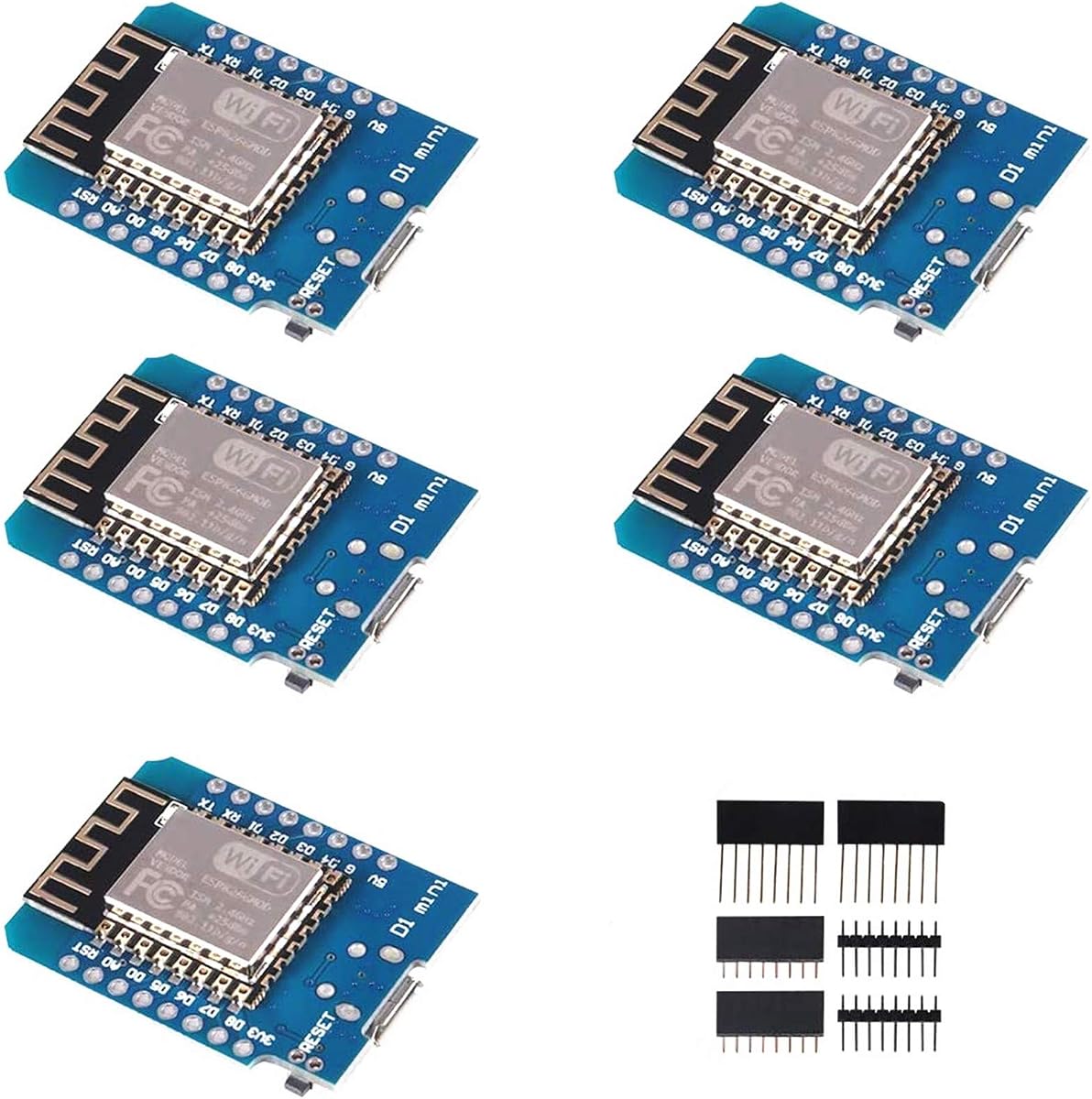
This D1 mini development board offers 11 digital input and output pins with interrupt and PWM support making it versatile for sensor and actuator connections. It includes 4M Bytes of Flash and a 5V 1A switching power supply onboard ensuring stable operation for connected projects.
We may earn a commission when you buy through this link, at no additional cost to you.
The board is compatible with Arduino and WeMos frameworks allowing flexible programming options. Users value the ability to run Lua scripts directly alongside standard Arduino sketches. This flexibility makes it a strong candidate for diverse embedded applications requiring multiple peripherals.
Using Micro USB instead of the newer Type-C may be a minor inconvenience for modern setups. However the onboard power supply simplifies circuit design significantly by removing the need for separate voltage regulators in many cases.
For those needing a compact board with rich IO capabilities and onboard power this module is excellent. It is recommended for developers working on projects that require multiple digital inputs and robust wireless connectivity in a small package.
11 pins with interrupt support allow for connecting many sensors and controllers at once.
The 5V switching power supply makes wiring easier for various peripherals.
We may earn a commission when you buy through this link, at no additional cost to you.
The 10-Pack ESP8266 ESP-01 Serial WiFi Transceiver Module provides the largest volume option in this guide making it ideal for large-scale deployments. Users rate this highly for its robust on-board processing and ample storage capacity ensuring reliable operation across many nodes.
We may earn a commission when you buy through this link, at no additional cost to you.
Supporting AP STA and AP plus STA modes offers versatile networking options for different scenarios. This flexibility allows you to use the device as a standalone access point or a client connecting to existing networks. It streamlines development for complex IoT systems.
While the modules themselves are small and efficient you will need to plan for power management and programming interfaces. This means extra care in design but the payoff is a stable solution that can scale across many units without performance loss.
This pack is best for professionals or hobbyists running multi-node networks. It ensures you have enough units for a full test deployment plus spares all with reliable wireless capabilities to support your project's needs.
Ten units allow you to build a full sensor grid without worrying about running out of components.
Multiple modes let you design networks that adapt to different connectivity requirements.
We may earn a commission when you buy through this link, at no additional cost to you.
Choosing the right WiFi module depends on your specific project needs such as processing power connectivity range and budget. Understanding the key factors below will help you narrow down the options effectively.
Consider whether you need a basic serial module or a full microcontroller with dual-core processing. High-end options like ESP32-S3 or Renesas RA4M1 can handle complex tasks while basic ESP8266 modules suit simple data transmission.
Select a processor that matches your code complexity and data handling requirements.
Look for modules that support the latest WiFi standards like Wi-Fi 5 or Bluetooth 5.0 for better range and stability. Newer standards ensure your devices remain compatible with modern routers and smartphones.
Prioritize connectivity that ensures stable communication across your intended deployment area.
If your project is battery-powered focus on modules with low-power modes and deep sleep capabilities. Efficient power management extends battery life significantly for remote sensors.
Choose a module with power-saving features to maximize operational time without frequent charging.
Flash memory size affects how much code and data your module can store locally. Options with 4MB or more allow for more complex applications and data logging.
Ensure your selected module has enough flash for your intended firmware and storage needs.
Modules with USB-C interfaces make uploading code and powering the device simpler compared to those requiring external adapters. Integrated connectors reduce the need for extra hardware.
Opt for boards with built-in USB for easier development and faster prototyping.
Popular boards like Arduino UNO and ESP32 have extensive libraries and community support which simplifies troubleshooting. A strong ecosystem means more tutorials and example code are available.
Choose a platform with active community support to aid in development and problem-solving.
Check if your module runs on 3.3V or 5V logic to avoid compatibility issues with your main controller. Improper voltage can damage components and lead to project failure.
Verify voltage levels and use level shifters if connecting to incompatible logic levels.
Consider the physical dimensions and whether the module fits your enclosure or PCB layout. Smaller modules are ideal for wearables but might lack additional connectors.
Select a form factor that balances space constraints with necessary interface options.
Begin by connecting the module to your development board using the recommended voltage levels. Ensure that you use appropriate logic shifters if your mainboard operates at 5V while the WiFi module expects 3.3V.
Install the necessary drivers for your computer to recognize the module via USB. This step is crucial for uploading code and debugging without connection errors during the development process.
Store unused modules in anti-static bags to prevent damage from static electricity. Keep them in a dry place away from direct sunlight to maintain long-term reliability for future projects.
ESP32 modules typically offer dual-core processing Bluetooth connectivity and more GPIO pins compared to the single-core ESP8266. The ESP32 is generally better for complex IoT applications requiring more processing power and integrated Bluetooth.
Most basic modules can be powered directly from the Arduino board but high current WiFi transmission may require a separate stable power source. Always check the current requirements of your specific module to avoid brownouts.
You upload code using the Arduino IDE by selecting the appropriate board type like Generic ESP8266 Module. You will need a USB to UART adapter if the module lacks an onboard USB interface for programming.
Yes many of these modules support low power modes that make them suitable for battery powered applications. Using deep sleep features can significantly extend battery life for remote sensor nodes.
Instability may be due to poor power supply insufficient voltage levels or interference from other wireless devices. Ensure a stable 3.3V source and check for nearby signal sources that could disrupt your connection.
Most ESP modules are fully compatible with the Arduino IDE after installing the required board support packages. This allows you to use familiar syntax and libraries for wireless projects without a steep learning curve.
We explored ten top options ranging from budget friendly ESP8266 packs to premium Arduino boards with dual core processing. Each choice offers distinct advantages depending on your technical needs and project scale.
Focus on processing capabilities connectivity standards and ease of use when making your final decision. Prioritize reliability and power efficiency especially for battery operated devices.
Prices and availability change frequently so check current listings to confirm compatibility and cost before buying.